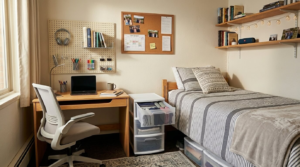
In a small dorm room, under the bed storage is usually the largest unused storage area available. Most students throw a few random items underneath the bed and call it storage. A suitcase ends up there. Shoes get kicked under. Maybe a box of stuff that never got properly unpacked. And that’s it. The problem isn’t lack of space, it’s a lack of system.
In many dorm rooms, the difference between a dorm room that feels chaotic and one that feels organized often comes down to what’s happening under the bed. Used intentionally, that space handles a significant portion of the room’s total storage needs without taking up an inch of visible floor space. Used randomly, it becomes the room’s junk drawer.
For under-bed storage ideas for small dorm rooms, this guide shows you how to measure the space correctly, decide what actually belongs there, which storage method suits which category of item, and how to organize the zone so it stays functional for the full semester.
Measure Your Bed Before Buying Anything
One of the most common dorm storage mistakes is buying storage bins before checking bed clearance. A container that’s one inch too tall becomes completely useless.
Measure the actual clearance in the actual room on move-in day before ordering anything. The measurement to take is from the floor to the lowest point of the bed frame, including any slats or center supports. That number, determines what fits.
If your dorm bed is adjustable or lofted, measure after it has been set to its final height.
When bed risers are worth it
If the current clearance is too low for the storage products that would be most useful, bed risers are the fix. A set of four risers adds height depending on the product, moving the clearance from inadequate to functional for a small investment. Look for risers with a built-in outlet if the room is short on power points, since the space beside the bed becomes a useful charging location.
Check the school’s policy on risers before purchasing, since some schools restrict certain heights and styles.
Step 1: Decide What Belongs Under the Bed
Not everything benefits from under-bed storage. The items that belong there share a common trait: they’re needed occasionally rather than constantly. The items that don’t belong there are the ones used daily.
Getting that distinction right before anything goes under the bed determines whether the system stays functional or becomes a frustrating excavation every time something is needed.
Best items for under-bed storage
Extra bedding is the strongest candidate. A spare comforter set, extra pillowcases and a backup blanket take up significant shelf or closet space but are only retrieved on laundry day or during a seasonal changeover. Under the bed is exactly the right place for them.
Out-of-season clothing is equally well suited. Winter coats, heavy sweaters and boots in September, summer clothes and sandals in January: whichever season isn’t currently happening doesn’t need to be accessible and can compress into vacuum bags under the bed without being missed.
Suitcases and luggage live well under the bed when the clearance allows, especially when filled with additional storage rather than left empty. Bulk toiletries, a backup supply of shampoo, soap, paper towels and cleaning products, belong under the bed rather than taking up desk or closet space. Spare school supplies, extra notebooks, printer paper, a backup calculator, fit in a flat box under the bed and stay out of the way until needed. Cleaning supplies for the room, a small dustpan, disinfectant wipes, a hand vacuum, have no obvious home in a dorm room and store cleanly in a flat container under the bed.
Items that should stay elsewhere
A daily-use backpack does not belong under the bed. Reaching under the bed for the bag needed every morning creates a friction point that makes mornings harder and the system feel like more work than it’s worth. The backpack goes on a hook beside the door.
Frequently worn shoes don’t belong there either, for the same reason. Current-rotation shoes go on a wall-mounted rack or an over-door organizer. Under-bed shoe storage is for the pairs worn once a month or less.
Textbooks used every day belong on the desk shelf or in the backpack, not under the bed.
And food and snacks don’t belong under the bed at all. They attract pests, create moisture problems and violate most dorm room policies on food storage locations.
Step 2: Match the Storage Method to the Item
Not every storage container serves the same purpose.
Rolling bins
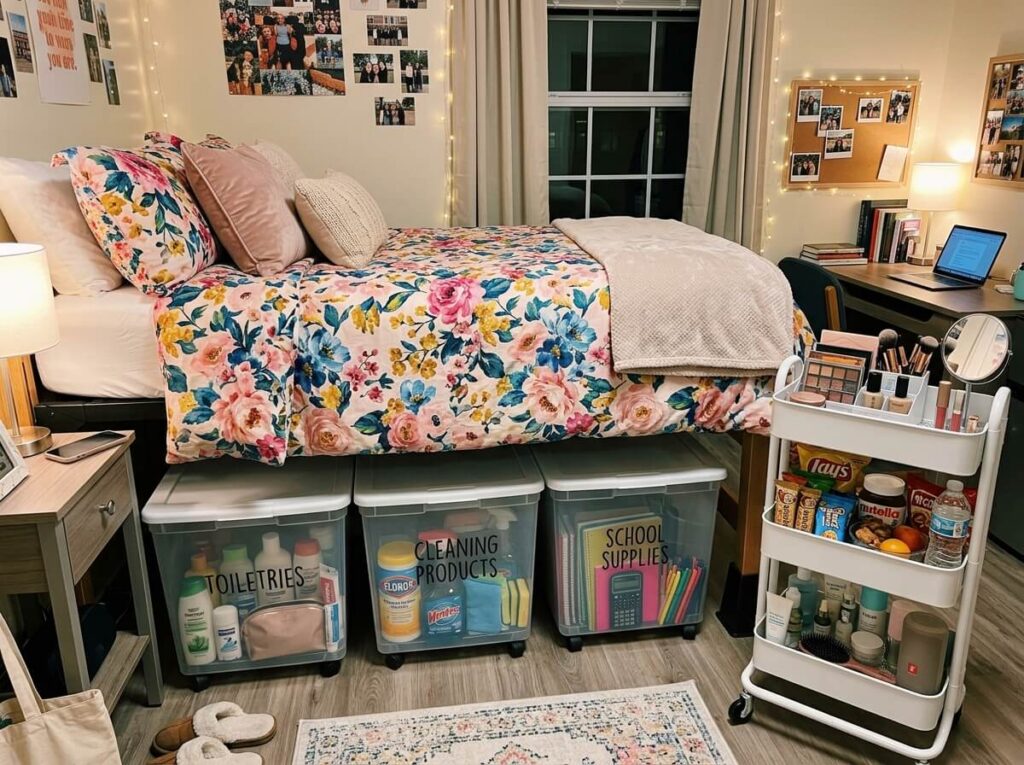
Rolling bins on wheels are the right choice for anything accessed regularly like extra toiletries, cleaning supplies, backup school supplies and shoes outside your daily rotation.
They slide out smoothly, make the contents visible and accessible, and slide back without effort.
Look for bins with wheels that lock if possible so the bin doesn’t drift. Clear or mesh-sided bins let you see the contents without pulling the bin all the way out, which saves time and keeps the system usable when you’re in a hurry.
Vacuum storage bags
Vacuum compression bags are great for bulky items like comforters, winter coats and heavy knitwear.
A standard comforter compressed into a vacuum bag reduces significantly, which means it stores flat under the bed instead of competing with everything else for clearance. The bags seal airtight, protecting contents from dust and moisture, and the flat profile allows multiple bags to stack with room to spare.
Flat storage boxes
Flat lidded boxes, the kind that slide rather than roll, school supplies, toiletries and smaller miscellaneous items that don’t need to be accessed constantly.
Label the outside of every box on the side facing outward so the label is readable without pulling the container out. Without labels, the contents become effectively invisible and retrieving a specific item means pulling out multiple boxes until the right one appears.
Using the suitcase as storage
An empty suitcase under the bed is wasted space. Fill it with out-of-season clothing, formal wear or spare bedding before it goes under and it becomes one of the most space-efficient storage containers in the room.
A luggage tag on the handle noting the contents makes retrieval immediate. For the full range of options for storing luggage in a small dorm room, including when the suitcase doesn’t fit under the bed, the post on where to store suitcases in a small dorm room covers every position and configuration.
Step 3: Organize the Space by Access Frequency
Students often fill the easiest-to-reach area with things they rarely use and push everyday items to the back. That’s the most common reason under-bed storage feels like more trouble than it’s worth.
A better system is to divide the space into three zones.
Front zone: Weekly-use items
The near side, the section reachable without bending down or pulling anything out, is for frequently accessed items. Rolling bins with shoes in current rotation, the backup supply box, anything retrieved weekly. This section should never require more than one pull to access what’s needed.
Middle zone: Monthly-use items
The middle section handles occasional-use items. Things accessed monthly: the extra bedding set for laundry day, the box of backup school supplies, the cleaning kit. These go in flat boxes that slide out cleanly but don’t need to be at the front.
Back zone: Long-term storage
The far side, against the wall, is for long-term storage. Vacuum-compressed out-of-season clothing, the empty suitcase filled with seasonal items, formal wear not needed until a school break. These items are placed once at the start of the semester and retrieved once at the end or during breaks. They belong as far back as the space allows so they never compete for position with items accessed more often.
If Your Bed Is Lofted
A lofted bed changes the under-bed equation completely. Instead of becoming a storage zone, the area underneath can become an entire functional zone of the room.
Such setups include:
- A desk under the lofted bed creates a complete study zone in the footprint of the bed.
- A clothing rail with a slim dresser or stackable drawers beside it creates a full dressing area.
- A combination of the two, desk on one side and clothing storage, splits the space into two functional zones.
What to avoid is using the lofted space as a dumping zone. Assign a purpose to the lofted under-bed space on move-in day and set it up deliberately.
Common Under-Bed Storage Mistakes
- Buying bins before measuring. Measure first, buy second, every time.
- Mixing unrelated categories in the same container makes everything harder to find. Each container holds one category.
- Storing loose items without containers. Everything that goes under the bed goes in a container.
- Forgetting labels. An unlabeled box under the bed is a mystery box that requires opening to identify.
- Keeping an empty suitcase under the bed when it could be storing something is a straightforward waste of the most valuable storage.
- Treating the under-bed zone like a junk drawer where anything with no other home ends up. The under-bed zone is a storage system, not an overflow pile.
Make the under-bed storage Part of a Larger System
The under-bed zone works best as part of a whole-room storage system rather than a standalone solution. The items that don’t belong under the bed need homes too, and those homes need to be set up with the same thoughtfulness.
For the complete room approach see, how to organize a small dorm room when space is limited.
For students with no closet or a closet that’s too small to handle clothing properly, the under-bed zone picks up significant additional storage load. The post on dorm room storage ideas when you have no closet space covers how to set up clothing storage outside the closet and how the under-bed zone fits into that system.
The Under-Bed Zone Is the Room’s Best Asset
Used well, it handles bedding, seasonal clothing, luggage, bulk supplies and backup items without occupying a single inch of visible floor or wall space. Used poorly, it’s a place where things go missing and stay missing.
The difference is three things: measure before buying, categorize before storing, and zone the space by access frequency. Get those three right and the under-bed zone does more work than any other storage area in the room.