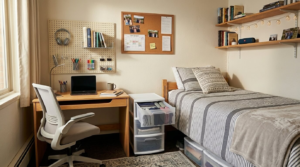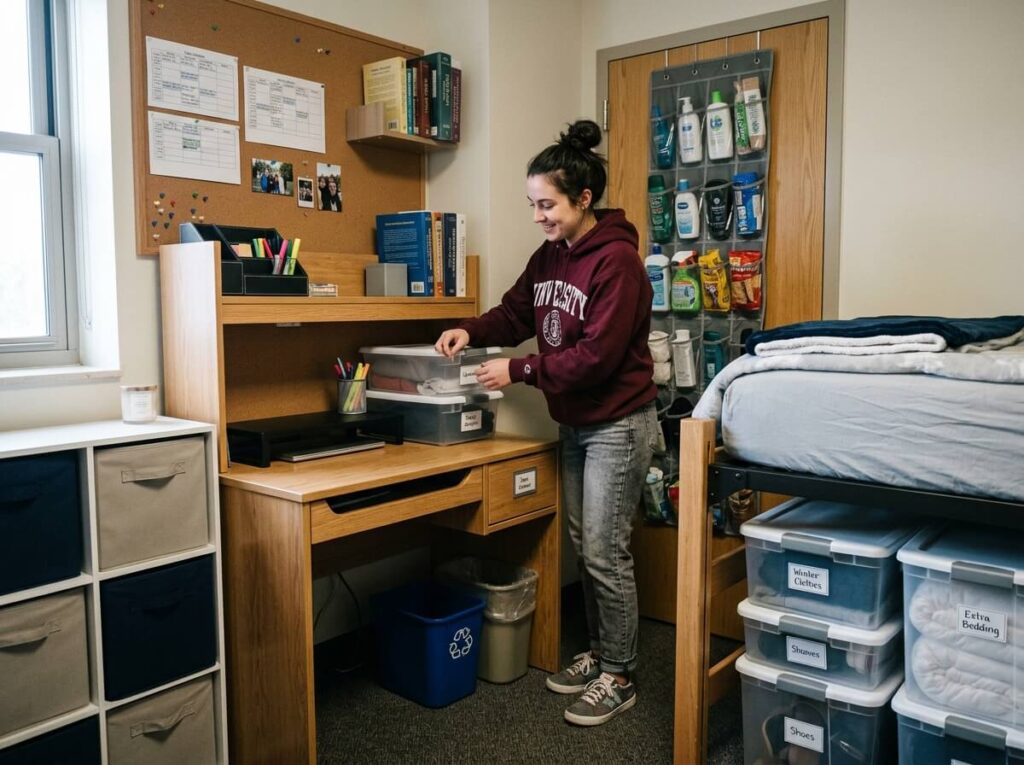
Most dorm rooms organization tips focus on move-in day. They show you the bins, shelves, hooks, and organizers to buy, then assume the room will stay organized on its own. In reality, that’s not what happens.
A dorm room can be perfectly organized in August and completely chaotic by midterms using the exact same storage products. The problem usually isn’t the lack of storage. It’s a system that requires more effort to maintain than most students can realistically give once classes, assignments, social events, and late nights start piling up.
The best small dorm room organization systems aren’t necessarily the prettiest. They’re the ones that still work when you’re busy, tired, and not thinking about organization at all.
This guide focuses on the habits and systems that help keep a dorm room organized all semester, not just during the first week after move-in.
Start With Less Than You Think You Need
Most organization problems begin before move-in day, with too much packed into the car. Excess possessions are the root cause behind a huge share of dorm room clutter, and no storage system fully compensates for simply having too much stuff for the space.
Too many clothes is the most common excess. A semester’s wardrobe doesn’t need to include every item owned, just what gets worn regularly.
Duplicate items are the second: two phone chargers when one would do, three water bottles, multiples of things that only need to exist once in a room this size.
Bringing items just in case is the third and the hardest to resist, since that reasoning always sounds sensible in the moment and rarely gets used in practice.
The rule that prevents all three: if it doesn’t have a designated home in the room, it doesn’t come. Not the vague intention to find somewhere for it later. A specific shelf, drawer or hook, decided before it’s packed. If that home doesn’t exist yet, the item stays behind until it does.
Give Every Category a Home
Students don’t usually struggle because they own too much. They struggle because individual items don’t have an assigned location, which means every single one becomes a small decision every time it needs to be put away. Multiply that by everything in a dorm room and putting things away starts to feel like constant effort rather than a quick habit.
The backpack has a hook by the door, every day, no exceptions. Shoes have a rack or an over-door organizer, not the floor. Chargers have a specific spot on the desk or in a drawer organizer, not wherever they were left last. Laundry has a basket positioned exactly where clothes come off, not a chair. School supplies have a drawer or a desktop organizer, not a pile.
Once every category has one specific home, putting things away stops being a decision and becomes a reflex.
That shift, from decision to reflex, is the entire difference between a system that survives midterms and one that doesn’t.
Keep Daily-Use Items Visible
Storage placement should follow how often something gets used, not how neatly it fits somewhere.
Daily-use items belong somewhere visible and immediately reachable. Weekly-use items belong somewhere accessible but one step removed, a drawer rather than open air. Rare-use items belong hidden away entirely, in the zone that takes more effort to reach.
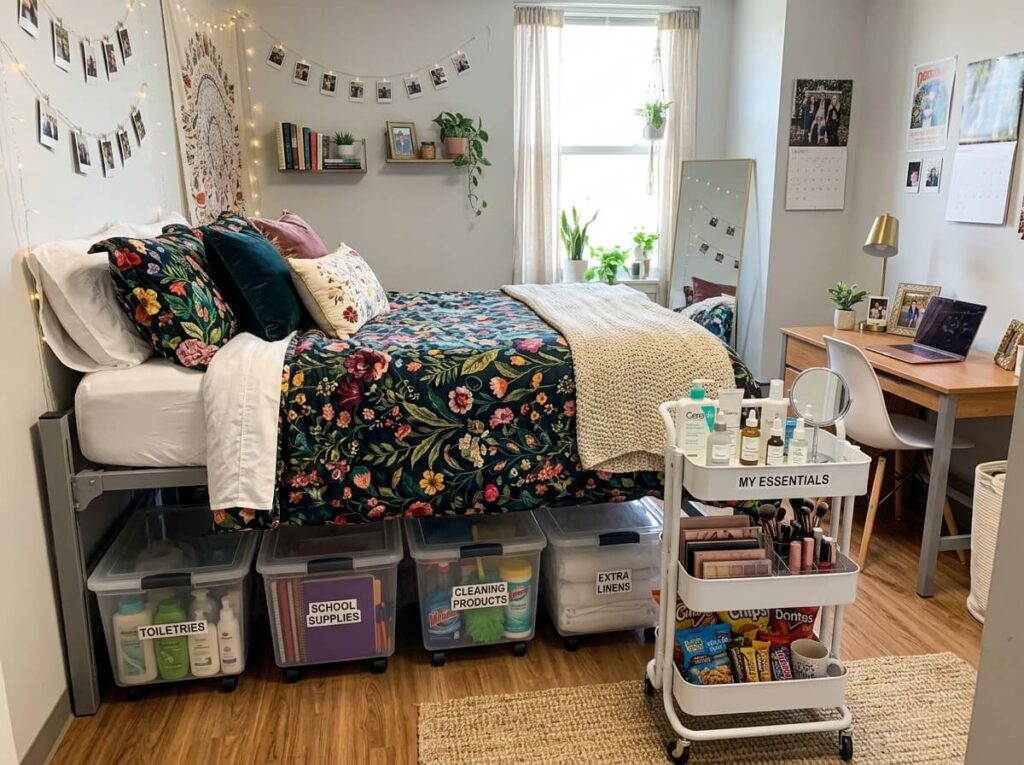
Getting this hierarchy backward is one of the most common reasons a system fails. When the things used every day are buried in the hardest-to-reach spot, putting them away becomes annoying enough that they start getting left out instead. A system only survives if using it correctly is the easy option.
The Three Habits That Prevent Dorm Room Clutter
Most dorm room organization systems succeed or fail based on a handful of small habits rather than the storage products themselves.
Never leave the room empty-handed
Every time you leave, take one thing that doesn’t belong where it is. A water bottle goes back to the sink, trash goes to the bin, a library book goes into your backpack. Small corrections throughout the day prevent clutter from accumulating into a larger problem.
Reset the desk before bed
The desk is usually the first surface to collect clutter and the first place that affects productivity the next day. Spending one minute clearing notebooks, wrappers, dishes, and miscellaneous items before bed creates a clean starting point the next morning.
Put laundry away within 24 hours
Clean laundry sitting in a basket is one of the fastest ways for an organized room to start looking messy again. Folding and putting clothes away within a day prevents the laundry basket from becoming a second wardrobe and keeps clothing from spreading across chairs, beds, and floors.
Reset the Room for Five Minutes Each Night
The cleanest dorm rooms aren’t cleaned less often. They’re reset more often. A deep clean once a month doesn’t prevent the slow daily drift that makes a room feel chaotic in between. A short reset every night does.
The nightly routine doesn’t need to be elaborate. Shoes go back on the rack. The desk gets cleared of whatever accumulated during the day. The trash gets emptied if it’s full. Anything that ended up somewhere it doesn’t belong goes back to its actual home. Five minutes, done at roughly the same point in the evening so it becomes automatic rather than something that has to be remembered.
This works because five minutes of daily maintenance is dramatically less effort than the hour it takes to fix a room that’s been drifting for two weeks. The math always favors the nightly reset. It just doesn’t feel that way until the two-week version has been lived through once.
Don’t Let Flat Surfaces Become Storage
The desk, the top of the dresser and the windowsill are the three surfaces most likely to quietly turn into general storage in a dorm room, and once one does, it tends to spread.
A single item left on the desk doesn’t look like a problem. A desk with twelve random items on it looks like the whole room has given up.
Flat surfaces are one of the biggest sources of visible clutter precisely because they’re so easy to set things down on without thinking. The desk should hold only what’s actively being used for the current task. The dresser top should hold only what doesn’t have a better home, ideally close to nothing. The windowsill should hold what belongs there, a plant, maybe a small lamp, not a holding pen for whatever didn’t get put away.
Treat every flat surface as off-limits for anything without an explicit reason to be there.
Use Vertical Space Before Adding Furniture
Before buying another bin or another small dresser, check whether the walls and door can do the job instead.
Hooks handle bags and daily-use items without any floor footprint. A pegboard above the desk handles supplies and small items in a configuration that adapts as needs change. Over-door organizers handle shoes and accessories on a surface most students never think to use.
For the full range of no-drill vertical storage options that work in a dorm room, how to maximize vertical space in a dorm room without drilling covers what holds, what doesn’t and what to use instead on rougher wall surfaces.
More furniture means less floor space and more things to maintain. Vertical storage solves the same problem without that tradeoff.
Reorganize at Mid-Semester
This is one of the more useful things to plan for. A system set up on move-in day is built for the needs that existed on move-in day. Those needs change.
Winter clothes arrive partway through fall semester and need a place that didn’t exist in August. Books and papers accumulate steadily and the supplies drawer that worked fine in week two is overflowing by week ten. New purchases, gifts, things picked up along the way: all of it adds up gradually until the original system is handling roughly twice what it was designed for.
A twenty-minute reset around the midpoint of the semester catches this before it becomes a real problem.
Go through the room the same way it was set up initially: confirm every category still has a home, check whether anything has outgrown its space, and adjust the few zones that need it.
It’s a fraction of the time the original setup took and it keeps the system matched to what the room actually contains rather than what it contained three months ago.
Create Friction for Clutter, Not for Organization
This is the single most useful concept here. The organized choice needs to be the easy choice.
If putting something away takes more effort than leaving it out, it gets left out, every time.
A laundry basket positioned exactly where clothes come off, not across the room, means dropping clothes in it takes the same effort as dropping them on the floor. A hook beside the door at exactly the height the backpack naturally swings to means hanging it up takes no extra movement compared to dropping it. A trash can beside the desk rather than across the room means wrappers and scrap paper go in the bin instead of accumulating on the surface.
Every one of these is a tiny adjustment to physical position, not a change in willpower. That’s the point. A system designed around convenience survives the weeks.
Focus on Systems, Not Motivation
Motivation is unreliable. It’s high on move-in day and during the week before parents visit, and it’s nowhere to be found during midterms or the week everything is due at once.
A room that depends on staying motivated to stay organized will be organized for exactly as long as the motivation lasts, which historically isn’t very long.
The most organized students aren’t necessarily the tidiest people. Their rooms are simply set up so that staying organized takes less effort than not bothering. Every home assigned to every category, every nightly reset, every piece of friction removed from the right choice: none of it depends on feeling like it that day. It just happens because the room is built that way.
Build the system once, with the habits in this post layered on top of it, and the room stays functional through the parts of the semester when nobody has the energy to think about organization at all.
For the full setup that this maintenance system is designed to protect, how to organize a small dorm room when space is limited covers building that initial structure from the ground up.
The System Outlasts the Motivation
A dorm room doesn’t stay organized because someone feels motivated every day. It stays organized because the system makes the organized choice the easiest.
Bring less than you think you need. Give every category a home. Keep daily-use items visible and easy to reach. Reset the room for a few minutes each evening and make small adjustments as the semester changes.
None of these habits are complicated. Together, they’re what separate a room that stays functional all semester from one that slowly falls apart after move-in week.