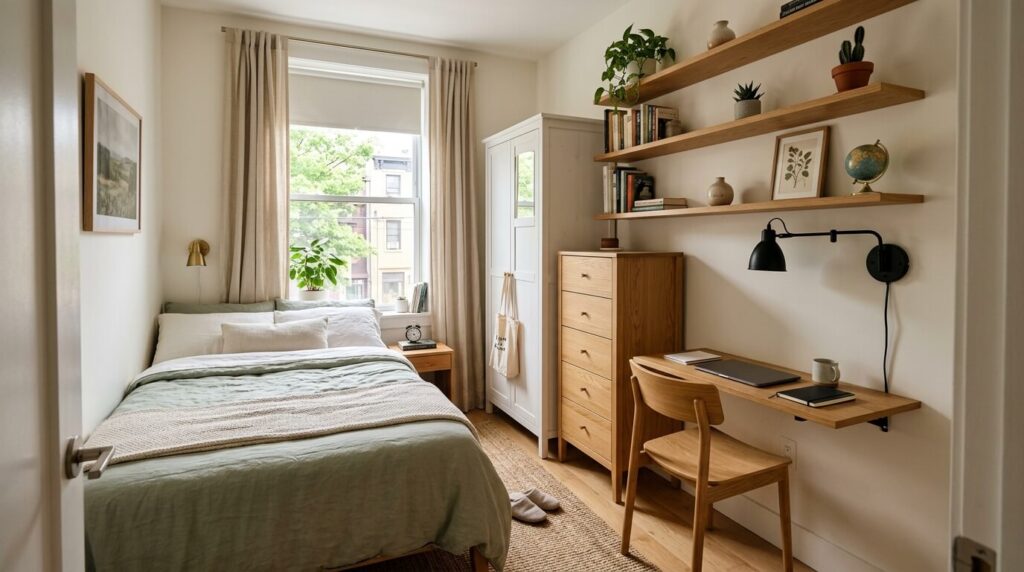
A narrow bedroom can feel harder to arrange than a room that is simply small. The issue isn’t just size. It’s proportion. When a room is significantly longer than it is wide, the wrong furniture placement can make it feel like a hallway instead of a bedroom
The good news is that a small narrow bedroom layout can work extremely well when the furniture is arranged around the room’s shape instead of against it.
This guide explains how to arrange furniture in a small narrow bedroom, where to place the bed, the best spots for storage, how to fit a desk, and simple ways to make the room feel wider and more open.
What Counts as a Narrow Bedroom
Many bedrooms rectangular, but not all feel narrow. A room that’s ten feet wide and twelve feet long is rectangular, but its proportions are manageable and most standard layout approaches will work reasonably well in it.
A room that’s seven feet wide and twelve feet long creates a different challenge because width becomes the limited resource.
In a narrow room:
- Walking space matters more
- Furniture depth matters more
- Oversized pieces quickly overwhelm the room
- The centre path must stay open
Once you understand that, arranging the room becomes easier.
Start With the Bed First
The bed is the largest item in the room, so it should be placed before anything else.
In many small narrow bedrooms, the long wall is the best place for the bed. It distributes the remaining floor space in a way that feels balanced and keeps the room from looking like a corridor.
If the room is extremely narrow placing the bed on the short wall is often the more practical choice, even though it produces the corridor effect that’s usually worth avoiding. However, it’s better to have a room that looks like a corridor but moves well than one that looks more balanced but is genuinely difficult to use.
For solo sleepers in very narrow rooms, the corner tuck is worth considering seriously. The bed goes into one corner with the headboard on the short wall and one side against the long wall, which frees up more of the central floor space than any other placement option. It’s the most space-efficient arrangement available in a narrow room.
Protect the Centre Walking Path
In a narrow bedroom, the central floor space running the length of the room is the most important space in the layout.
It’s where you walk, where you get dressed, where the room breathes. Every furniture decision should be evaluated against a single question: does this protect the central path or does it eat into it?
Whenever possible:
- Keep one clear path from the door to bed
- Avoid furniture sticking deep into the room
- Choose shallow furniture instead of bulky pieces
- Keep chairs able to tuck fully
If the centre path stays open, the room instantly feels better.
Furniture That Works in a Narrow Bedroom
Shallow furniture
The most useful habit in arranging a narrow bedroom is to think in terms of depth rather than width. The shallow pieces almost always serve the layout better.
A wide dresser that is shallow often works better than a narrower dresser that sticks far into the room.
Tall, narrow pieces
Tall and narrow pieces work better than wide and low ones in most cases. A tall chest of five or six drawers takes up a small footprint on the floor and keeps storage vertical, which is exactly what a narrow room needs.
A long low dresser takes up more of the long wall and sits in the sightline at a height that makes the room feel more compressed. The tall piece tucks itself into the room. The low piece spreads across it.
Wall-mounted furniture
Wall-mounted shelves above the bed, a floating desk along the wall, wall-mounted bedside shelves instead of freestanding nightstands: all of these give you the function without adding to the floor space used.
Multi-functional furniture
A storage bed that combines the sleeping surface with substantial under-bed storage removes the need for a separate large storage piece elsewhere in the room.
An ottoman at the foot of the bed that also opens for storage serves two purposes in the footprint of one.
A desk that folds down from the wall and closes away when not in use gives you a work surface without permanently occupying wall space or floor space. Each of these choices frees up room for the furniture you genuinely can’t consolidate.
Where to Put the Dresser in a Narrow Bedroom
The dresser is one of the most frequently misplaced pieces of furniture in a narrow bedroom, partly because it’s large and there are genuinely limited options for where it can go, and partly because the most obvious positions are often the ones that cause the most problems.
The short wall at the foot of the bed is usually the best position for a dresser in a narrow bedroom. This keeps the dresser off the long walls and protects the walk space.
A tall narrow chest works particularly well here because it uses the height of the short wall without spreading across too much of its width.
Avoid placing a full-sized dresser on the long wall opposite the. A dresser on the long wall projects into the central path, narrows the room visually, and competes with the bed for the same sightline in a way that makes the room feel crowded from every angle.
How to Fit a Desk in a Small Narrow Bedroom
Fitting a desk into a narrow bedroom on top of everything else is a challenge that comes up often, particularly in rooms that double as a home office or a study space.
The best narrow bedroom furniture ideas for desks include:
Fold-down desk
A wall-mounted fold-down desk is the strongest option in a narrow bedroom because it removes itself from the room entirely when it’s not in use. You can have a fold-down desk on the long wall between the bed and the door, or on the short wall beside the wardrobe.
Corner desk
The desk sits in the corner rather than along the wall, which means it uses the least-trafficked part of the room and doesn’t project into the central path.
The corner position also naturally encloses the work zone, which helps with the visual separation between the sleeping area and the desk area that becomes harder to achieve in a narrow room where everything is closer together.
Slim wall desk
A desk along the long wall works only if the room is wide enough to allow a chair to be pulled out without it blocking the central path. Measure the depth of the desk plus the space a pulled-out chair needs, and check what that leaves in the middle before committing to a long wall desk position in a narrow room.
How to Make a Narrow Bedroom Look Wider
Perception matters in a small bedroom, not because it changes the actual dimensions but because a room that feels wider than it is stays more comfortable to live. Several straightforward approaches can be used to make a narrow bedroom look wider, by focusing on visual balance.
Use mirrors on the short walls
A large mirror can reflect light and create the impression of a room that extends further than it does.
Keep long walls light
Keeping the long walls as light in colour as possible helps the room feel less compressed laterally. Light colours on the long walls push those walls back visually, while dark or heavily patterned walls on either side of a narrow room bring them in and emphasise the narrowness.
Show more floor
Keeping the floor as visible as possible amplifies all of these effects. Furniture with legs that show the floor beneath them, rather than pieces that sit flush to the ground, creates the impression of more floor space than actually exists.
Use rugs sideways
Place rugs across the room rather than lengthwise to visually widen the space by drawing the eye across rather than along.
Common Mistakes That Make Narrow Bedrooms Feel Smaller
Most of the things that make a narrow bedroom feel worse than it should come down to decisions that prioritise convenience or familiarity over the specific demands of the room’s proportions.
Putting furniture along all four walls
This is perhaps the most common mistake in a narrow bedroom which results is a room where the central floor space shrinks to whatever is left after every wall has been lined.
Putting Tall furniture on the long walls
Tall furniture on the long walls emphasizes the height of the walls relative to the width of the room, which reinforces the tunnel-like quality of the space rather than softening it.
Using deep furniture
Depth steals walking space quickly
Rugs that run lengthwise
Rugs that run lengthwise, oriented with the long edge parallel to the long walls, repeat the shape of the room and reinforce its narrowness.
Blocking Windows
Heavy window treatments on the long wall windows, block natural light and make the walls feel closer. Keeping the window covering as light and minimal as possible lets the wall recede rather than advance.
Choosing bulky nightstands
Floating shelves often work better
Best Layout Examples
Very narrow room
- Bed on the short wall
- Tall dresser on the opposite wall
- Floating shelf beside the table
- Fold-down desk on the side wall
Medium narrow room
- Bed on the long wall
- Dresser at the foot of the bed
- Desk on the opposite wall
- Shelves above the desk
Narrow room with no closet
- Bed on the long wall
- Wardrobe on the short wall
- Under-bed storage
- Wall hooks behind the door
A Narrow Bedroom Can Work Well if You Let It
Learning how to arrange furniture in a small narrow bedroom is less about decorating and more about protecting space and respecting the room’s proportions.
Start with the bed placement, keep the centre path clear, choose shallow furniture and consider walls for storage.
A narrow bedroom arranged well doesn’t feel like a room that’s making the best of a bad situation. It feels like a room where the shape was understood and used properly.