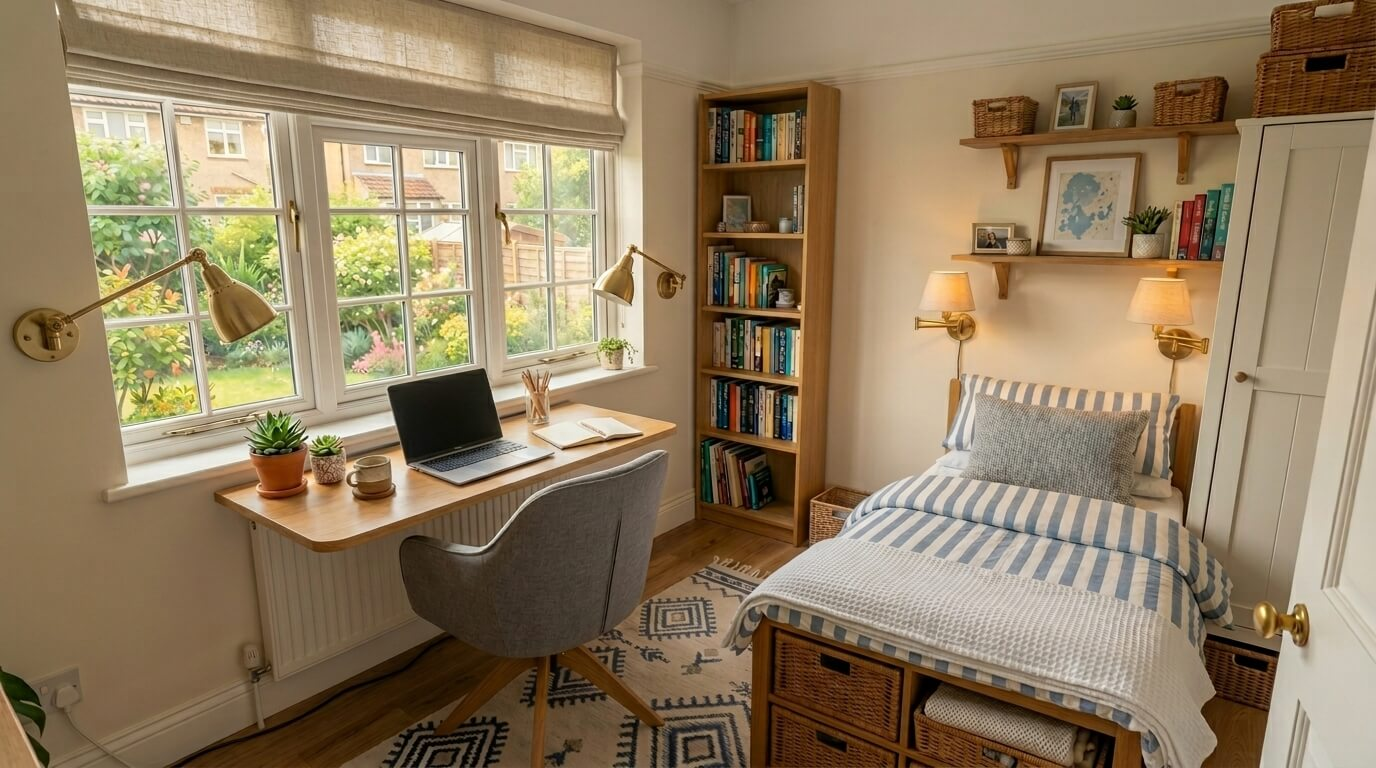
Small Bedroom Layout with Desk and Storage Ideas
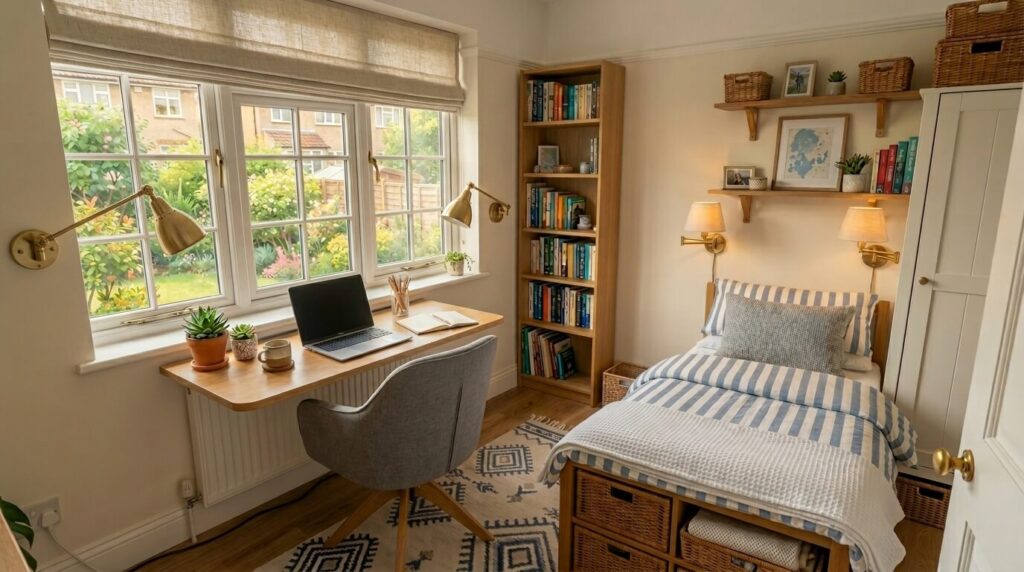
Trying to fit a bed, desk, and proper storage into one small bedroom can feel impossible at first. The bed already takes up most of the room, the storage needs to go somewhere that doesn’t block everything else, and the desk needs to be in a spot where you can actually sit and work comfortably.
The good news is that this is mostly a layout problem rather than a space problem.
With the right setup, one room can work for sleeping, and staying organized without feeling overcrowded. The key is placing each item where it functions instead of forcing furniture into whatever space is left.
This guide covers the best small bedroom layout with desk and storage ideas, where to place the desk, storage solutions that work around both the bed and the desk, and the specific layouts that actually work in a compact room.
Start With the Bed Placement
The bed is the biggest piece of furniture in the room, so it has to be placed first. Everything else, including the desk and storage, works around it rather than the other way around.
In many small bedrooms, placing the bed on the long wall creates the best flow and leaves more flexible wall space for a desk or storage.
The Best Spots for a Desk in a Small Bedroom
Once the bed is placed, there are four realistic positions for a desk in a small bedroom, and each one suits a slightly different room shape and set of priorities.
1. On the remaining section of the long wall
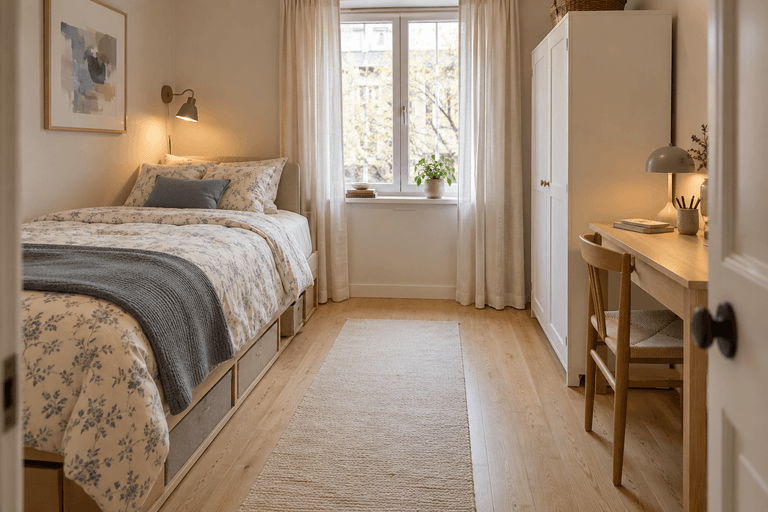
If the bed uses part of the long wall, the unused section can often hold a desk, a chair, and shelving above it.
The room stays visually balanced because the desk and bed share the same wall without interfering with each other. The floor space in the middle of the room stays relatively open.
This works particularly well in rooms that are longer than they are wide, where the long wall has enough room for both pieces without them feeling crowded together.
2. In a corner
A corner position is worth considering in almost any small bedroom because it makes use of space that would otherwise go unused.
This is a strong option in tight bedroom because it keeps a corner desk, or a narrow desk with shelving on the adjacent wall tucked away while preserving the centre of the room. The drawback is that corners can feel closed in if they’re not styled well. Good lighting above the desk therefore becomes especially important in this position.
3. Beside a window
Natural light makes almost any desk in a small bedroom feel significantly more pleasant to work at.
However, a desk that sits directly in front of a window, with the screen facing the glass, will create glare problems during certain parts of the day. Positioning the desk so the window is to the side rather than directly behind or in front of the screen solves this without giving up the light. Blackout curtains are also an option to prevent the glare.
4. At the foot of the bed
A desk at the foot of the bed can work if there is enough clearance between the bed and the facing wall, typically at least five feet.
This suits slightly larger small rooms though. In tighter rooms, this position can feel uncomfortably close to the bed, and it tends to blur the line between the sleeping space and the work space more than the other positions do.
Desk Ideas That Save Floor Space
The desk itself is just as important as where you put it. A large, deep desk in a small bedroom takes up floor space the room can’t afford, and it makes the work space feel overwhelming and out of proportion with the rest of the room.
The better options are pieces that do the job without dominating the space around them.
Wall-Mounted Fold Down Desk
A wall-mounted fold-down desk is the most space-efficient option available for a small bedroom.
When not in use, it’s folded up against the wall, and takes up no floor space at all. When it’s folded down, it gives you a proper work surface that functions the same as any other desk.
These work especially well because physically removing the work zone from the room makes the bedroom feel more like a bedroom again.
Narrow writing desk
A narrow writing desk, typically between 40 and 48 inches wide and no more than 20 inches deep, is practical for most bedrooms.
It fits along most walls without projecting far into the room, it pairs well with wall-mounted shelving above it, and it’s available in styles that range from minimal and modern to warm and traditional.
The slim profile means it works in corner positions as well as along a wall.
Floating shelf desk
A deep floating shelf, around 20 to 24 inches, mounted at desk height gives you a work surface with no legs underneath it, which keeps the floor beneath it completely clear and looks minimal.
Paired with a chair that tucks under it fully when not in use, this can be an extremely unobtrusive desk solution in a very small room.
The limitation is that it works best for light tasks like writing, sketching, or using a laptop rather than heavier setups with multiple monitors.
How to Create a Desk Area That Feels Separate from the Bedroom
One of the genuine challenges of having a desk in a bedroom is that the room ends up feeling like it’s trying to be two things at once without fully committing to either. This is especially relevant for people who work from home and need the bedroom to function as a proper workspace during the day and a proper bedroom at night.
The most effective way to create separation between the two zones is through visual cues rather than physical barriers, since a small bedroom rarely has room for actual dividing structures.
Use a rug
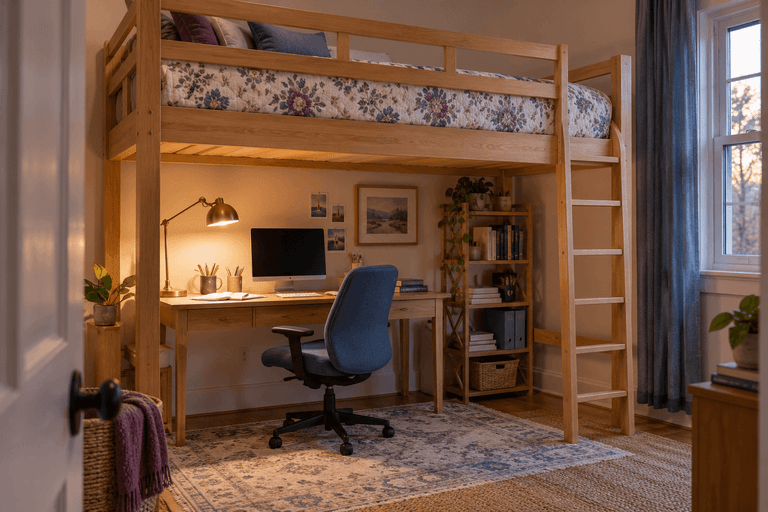
A rug under the desk defines the work zone as its own distinct area within the room, separate from the sleeping zone, without taking up any additional space or adding any visual weight overhead.
It works particularly well when the desk is in a corner or along a wall that’s clearly distinct from the bed wall.
Use task lighting
A dedicated desk lamp or a pendant light hung above the work area creates a pool of light that belongs specifically to the desk zone. When that light is on and the rest of the room is dim, the desk feels like a workspace. When it’s off and the bedroom lighting takes over, the room shifts back into a sleeping space.
That shift is a small thing but it makes a real difference in how the room feels at different points of the day.
Use vertical dividers
A narrow bookcase or open shelving unit placed at the side of the desk, perpendicular to the wall, can act as a soft visual divider between the desk zone and the rest of the room. It doesn’t block sightlines or light the way a solid partition would and it creates a subtle separation that makes the work area feel more focused and contained.
Storage Ideas That Work in a Small Bedroom
The best storage ideas for a small bedroom use vertical and hidden space rather than filling the floor.
Under-bed storage
Under-bed storage is the most valuable storage in a small bedroom because it uses space that would otherwise contribute nothing to the room.
A bed frame with built-in drawers is the tidiest approach, giving you several drawers worth of storage without adding any visible bulk to the room.
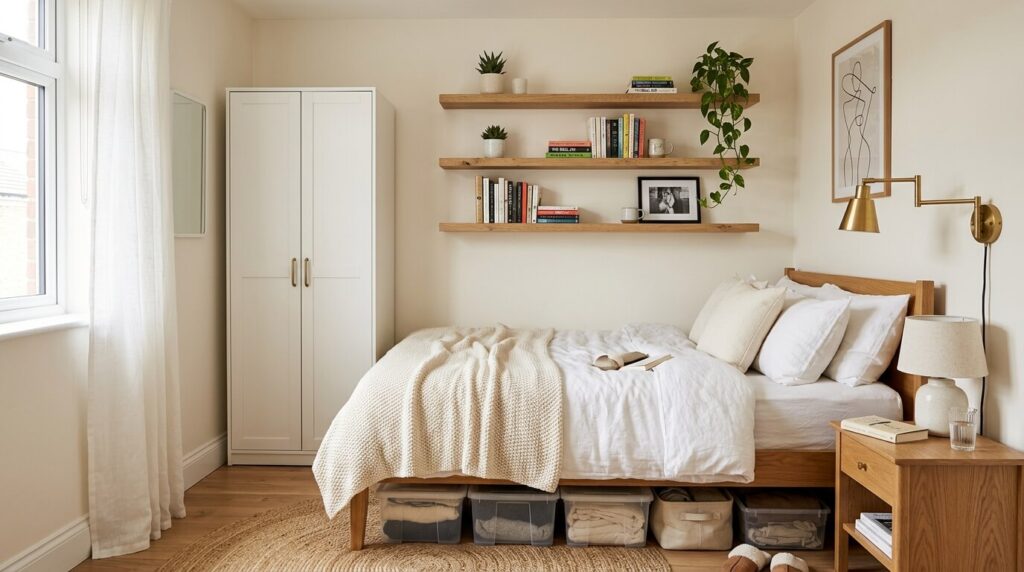
If your current bed frame doesn’t have drawers, low-profile storage boxes or rolling bins that slide under the bed work almost as well, though keeping them consistent in size and color makes the space feel more organized.
A lift-up storage bed, is worth serious consideration in a small bedroom that needs to handle a lot of belongings. The trade-off is that the storage is accessed by lifting the mattress, which means it suits things you need occasionally rather than every day.
Floating Wall storage
A wall-mounted shelf at mattress height gives you the same surface without taking up any floor space. A single drawer unit on the accessible side of the bed handles the things that need to be contained, and the other side can often manage with just a shelf or even nothing at all if the room is very tight.
Additionally, two or three floating shelves mounted above the desk can hold a substantial number of books, files, and equipment within reach without the zone feeling heavy or cluttered.
A pegboard on the wall behind or beside the desk is a practical option for anyone who uses the desk for creative work, crafts, or tasks that involve a lot of small tools and supplies.
Tall narrow storage
When floor space is limited, go upward instead of outward with furniture such as tall narrow dressers, vertical cube storage options, and slim wardrobes.
A slim bookcase that’s 12 to 14 inches deep that sits close to the wall, doesn’t project far into the room, and provides significantly more storage than shelves alone.
Best Layout Ideas by Room Shape to Fit Both a Desk and Storage
It helps to see how the pieces fit together in practice, so here are three layouts that work for different room shapes and storage needs.
Narrow Rectangular Bedroom
The bed on the long wall and a narrow desk on the remaining section of the same wall is the most functional arrangement.
Storage goes under the bed and on floating shelves above the desk. The short wall at the foot of the bed holds a slim tall dresser.
This layout keeps the floor space in the middle of the room as open as possible, which matters most in a narrow room where that central strip is the main circulation path.
Slightly wider bedroom
The bed on one wall and a corner desk in the opposite corner of the room creates a clear separation between the sleeping zone and the work zone. Place a storage bench at the foot of the bed and vertical storage beside the desk to keep the work zone self-contained.
Bedroom with no closet
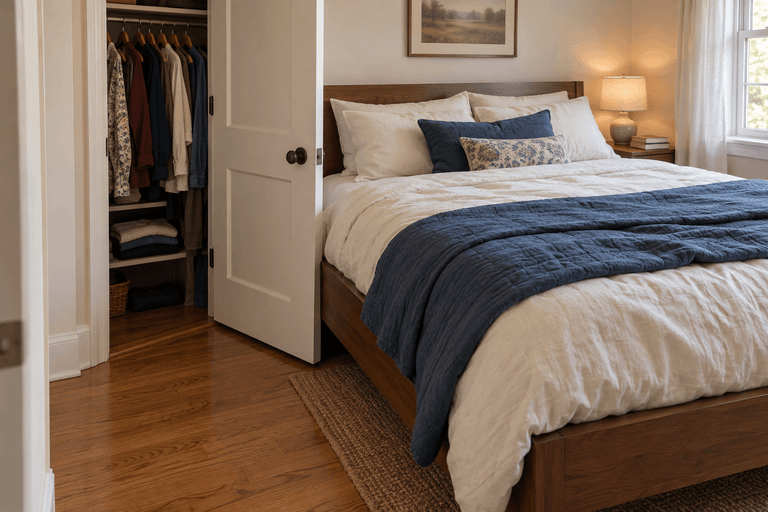
In a room that also needs a wardrobe, the wardrobe typically takes priority on the short wall opposite the bed, since its height and bulk make it difficult to place anywhere else without blocking light or dominating a visible wall.
The bed goes on the long wall, a fold-down desk on the remaining section of the long wall or a corner desk in the remaining corner gives you the work zone without competing with the wardrobe for the same wall space. An under-bed storage takes up the overflow. This article on how to organize a bedroom with no closet goes deeper into this.
Mistakes to Avoid
Choosing an oversized desk
An oversized desk in a small bedroom uses up floor space the room genuinely cannot spare. A narrower desk with good vertical storage above it gives you a more functional work zone than a wide desk with nothing around it.
Blocking the window
Blocking the window with the desk or with storage placed around it cuts off the natural light that makes a small bedroom feel livable. Whether or not the desk sits near the window, the area immediately around the window should stay as clear as possible so the light can travel into the room rather than being absorbed by furniture.
Using too much open shelving
Too many visible items quickly create clutter and makes the whole room feel chaotic, regardless of how well the layout itself is planned.
Ignoring cable management
Messy chords can make the whole room feel untidy.
Final Thoughts
A small bedroom can absolutely fit a bed, desk, and proper storage when the layout is planned.
Place the bed first and on the long wall wherever possible. Choose a desk that’s proportional to the room rather than the one you’d choose if space weren’t a consideration. Get the storage off the floor and onto the walls above the desk and under the bed. Define the work zone with lighting and a rug so the room can shift between its two purposes without one bleeding into the other.
Done well, the best small bedroom layout with a desk and storage are not about squeezing in more furniture, they are about making each piece work harder.