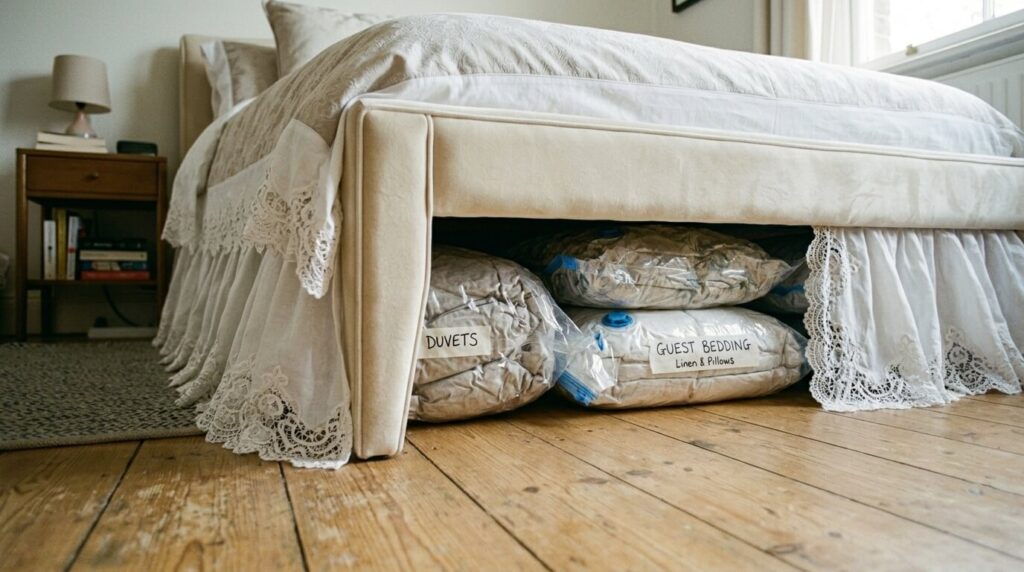
Knowing how to store bedding in a small bedroom can be surprisingly difficult when spare comforters, pillows, blankets and extra sheet sets take up more space than expected. Unlike clothing, bedding is bulky, awkward to fold neatly and often used infrequently, yet still needs to be accessible when laundry day or seasonal change arrives.
Without a proper storage system, spare bedding often ends up stacked on top of wardrobes, stuffed into corners, or taking up shelf space the room needs for other things. The good news is that most small bedrooms already have enough room to store bedding effectively. The key is using that space more intentionally.
The solutions below keep spare bedding contained, accessible and protected without allowing it to dominate valuable storage space.
The Problem with Bedding in a Small Bedroom
Bedding takes up surprisingly large amount of space. A spare comforter, extra pillows, seasonal blankets and backup sheet set can easily consume an entire shelf or storage unit on their own.
The challenge is that bedding doesn’t fit neatly into many standard storage solutions. It’s too bulky for most drawers, too soft to stack reliably on open shelves, and too large for the kinds of boxes and baskets that handle smaller items well. In a small bedroom, it needs its own dedicated solution that makes use of existing storage rather than requiring new furniture.
Before buying anything new, it’s worth identifying which areas of the room are already underused. In many cases, the answer is found under the bed, above the wardrobe or inside furniture that already exists.
Store Complete Bedding Sets Together
Before choosing a storage solution, organize bedding by complete sets.
One of the simplest tricks is to fold the fitted sheet, flat sheet and extra pillowcases together and store everything inside one matching pillow case. This keeps each set contained in a single bundle and prevents pieces becoming separated over time.
The approach also makes seasonal changes easier because the entire set can be retrieved at once rather than searching through multiple shelves or storage boxes.
For households with several bedding sets, labelling the pillowcase bundle by bed size can make retrieval even faster.
Under-the-Bed Storage
The space under the bed is the most practical location for spare bedding in a small bedroom, primarily because it suits items that are accessed occasionally rather than daily.
Vacuum compression bags
Vacuum compression bags are the single most space-efficient tool available for bedding storage. A standard comforter compressed into a vacuum bag reduces to roughly a third of its normal volume, which means it fits flat under most beds with room to spare. The bags seal airtight, which also protects the contents from dust and moisture.
For anyone storing more than one spare set, compression bags make the difference between fitting everything comfortably and running out of space entirely.
Flat zip storage bags
For bedding that doesn’t need to be compressed, flat zip storage bags provide a simple alternative. They keep bedding clean, organized and easy to identify while sliding neatly under the bed.
Using matching bags creates a more organized system and prevents the under-bed area from becoming a collection of unrelated items.
Under-bed storage boxes with lids
Rigid under-bed storage boxes work particularly well for lighter bedding such as spare sheets, pillowcases, folded throws and lighter summer comforters. The lid keeps contents dust-free while the rigid sides mean the boxes can slide in and out more easily.
Check the clearance height before buying since standard storage boxes vary.
Inside the Bed Itself
If under-bed space is already occupied by belongings, a storage bed can provide substantial hidden capacity without increasing the room’s footprint.
Ottoman beds and hydraulic lift beds both reveal a large storage compartment beneath the mattress, making them ideal for storing spare comforters, a set of pillows, spare throws and additional items alongside them.
Because the storage area is completely hidden, bedding remains out of sight while staying easily accessible when needed. For a small bedroom where storage space is limited, a bed is often one of the most efficient long-term investments available.
Inside the Wardrobe
The wardrobe is an underused bedding storage location in most small bedrooms.
Top shelf storage
The top shelf is often the best location for spare bedding because these items aren’t needed daily.
Folding a comforter as flat as possible and storing it alongside matching pillows keeps everything together while making use of space that often sits empty.
Vacuum bags inside the wardrobe
For wardrobes with limited shelf space, a vacuum-compressed bedding can fit into gaps that would otherwise be unusable.
A compressed comforter can often slide beside hanging clothes or fit neatly onto shelves that would struggle to accommodate it at full size.
Storage Ottomans and Benches
An ottoman box or a storage bench handles the bedding that’s in more regular rotation. Spare throws and blankets used on cold nights, lighter backup comforters and extra pillows remain easy to access.
Unlike a standard storage box, an ottoman also serves as a seating or a practical surface at the foot of the bed. This makes it a more space-efficient choice for a small bedroom.
Shelves and Vertical Storage
When the floor space is limited, vertical storage becomes increasingly valuable.
A high shelf above the wardrobe, door frame or headboard can hold spare bedding without taking up any usable floor area. The key is ensuring the bedding looks organized rather than oiled up.
The most efficient method is the pillowcase bundle technique, where each folded bedding set is stored inside one matching pillowcase. This creates uniform packages that stack neatly and stay together over time.
For more on using high shelves and upper wall space effectively, the post on how to maximize space in a small bedroom using vertical storage covers the full approach.
Best Places to Store Different Types of Bedding in a Small Bedroom
Different bedding items work better in different storage locations.
| Bedding Item | Best Storage Location |
| Spare comforter | Vacuum storage bag under the bed |
| Spare pillows | Storage bed or ottoman |
| Extra blankets and throws | Storage bench or ottoman |
| Guest bedding | Top wardrobe shelf |
| Seasonal bedding | Vacuum bags above wardrobe or under bed |
| Spare sheet set | Pillowcase bundle on shelves or in storage boxes |
Using the right location for each category prevents valuable storage from being wasted.
What Not to Do
One of the most common mistakes is storing bedding loosely on top of the wardrobe. Without a container, bedding looks untidy, collects dust quickly, and tends to accumulate additional items alongside it. Overtime, the top of the wardrobe becomes a general overflow zone. A simple storage bag, a basket, or a vacuum bag keeps the same storage location looking intentional.
Keeping more bedding than the room can reasonably store is the other consistent problem. Most small bedrooms need one or two spare sets in rotation for washing days and one seasonal set for the changeover. Everything beyond that should be assessed to determine whether it’s earning the space it occupies.
It’s worth keeping current bedding separate from spare bedding. Mixing both together often makes storage harder to maintain and creates unnecessary frustration when changing the bed.
Give Bedding a Permanent Home
Spare bedding becomes a problem when it moves constantly from one location to another without a designated storage spot.
Whether it’s stored under the bed in compression bags, inside a storage ottoman, on the top wardrobe shelf, giving bedding a permanent home makes it easier to manage. The choice depends on what space the bedroom has available. The guide to small bedroom storage ideas for tight spaces can help identify overlooked opportunities. If the room feels overloaded in general, how to organize a small bedroom with too much stuff can help address the bigger picture before refining individual storage categories.