How to Organize a Small Bedroom With Too Much Stuff
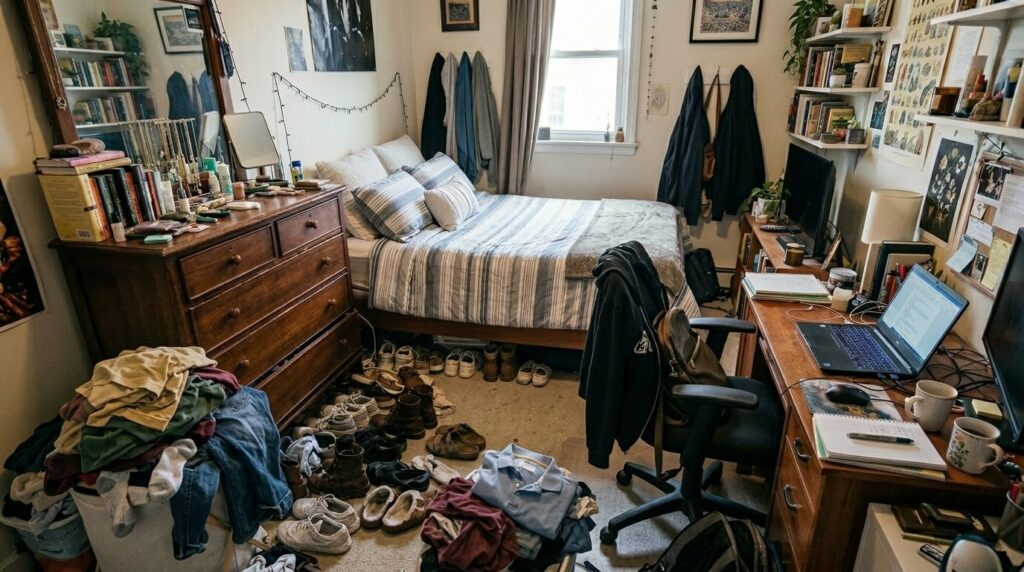
More storage is usually the first thing people look for when a bedroom feels overwhelming. Another set of drawers, a bigger wardrobe, extra baskets, shelves above the bed. But organizing a small bedroom with too much stuff starts differently from organizing a room that’s simply messy.
In a room that genuinely has too much in it, adding more storage often just gives the clutter a neater place to accumulate.
The real problem usually isn’t a lack of storage furniture. It’s that the room is holding more than it can comfortably support. Until the volume of belongings comes down, even the best small bedroom organization system struggles to hold.
The good news is that once the excess is reduced, organizing a cluttered bedroom becomes much easier. The room starts functioning properly again because every item finally has enough space to belong somewhere intentionally.
Too Much Stuff and Poor Organization Are Not the Same Thing
A disorganized bedroom and an overstuffed bedroom look similar but they need different solutions.
A disorganized bedroom has a reasonable amount of belongings in it but nothing has a fixed home, so things end up wherever they land. Better systems and designated homes for each category fixes that fairly quickly.
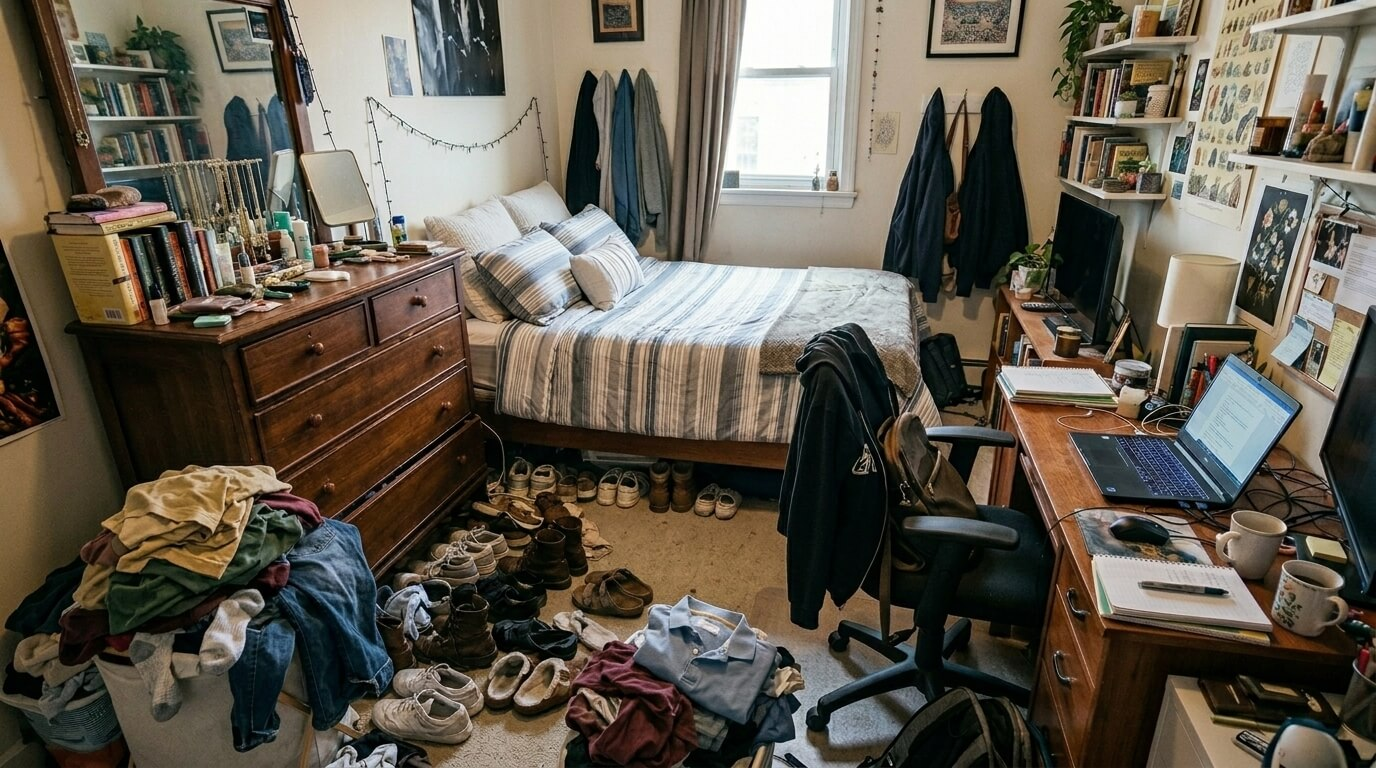
A bedroom with too much stuff on the other hand, has more in it than the space can hold regardless of how well it’s organized. Things don’t have homes because there isn’t room for homes for all of them. Drawers are overfilled, wardrobes are crammed, and storage bins start stacking on top of each other because there is nowhere else left to put things.
There is no need of buying more containers for a room in this state. It needs less volume first.
If you’ve repeatedly tried to organize a messy bedroom and it never stays under control for long, excess belongings are almost certainly the underlying problem rather than a lack of organization tools.
Start by Decluttering the Bedroom Properly
The fastest way to create space in a crowded bedroom is to remove what no longer needs to be there.
This is the step most people try to skip, but it is the foundation of every successful small bedroom storage system. Without it, the room stays under pressure no matter how well the drawers are arranged.
The goal isn’t extreme minimalism. The goal is a bedroom where the volume of belongings matches the space available to store them.
The one-year rule for clothing
For clothing, the simplest and most reliable filter is time. If something hasn’t been worn in the past year, it’s worth questioning whether it still deserves everyday storage space in the bedroom. Using time as the deciding factor removes a lot of emotional overthinking from the process.
Of course, exceptions exist. Formal wear for occasional events, sentimental pieces, seasonal wear, but applying the rule to the general wardrobe removes a significant portion of what’s taking up space.
Declutter by category, instead of by area
Going through the bedroom as a whole is overwhelming. Going through one category at a time is manageable.
Start with clothing first, then shoes, then books, then miscellaneous items, then anything that doesn’t have an obvious category.
Completing one category fully before moving to the next creates visible progress early. This makes the process easier to continue.
If you have a ton of shoes that feel consistently chaotic for the longest time despite repeated attempts to tidy them, this post on how to store shoes in small bedroom gets into practical organization systems for shoes that will help you.
Remove items from the room immediately
One of the biggest mistakes during decluttering is creating “temporary” piles that never actually leave. Having a clear plan for removed items before starting makes the process faster and less likely to stall.
A bag for charity, a box for selling or a pile for other rooms in the home if that’s an option. Items that are leaving the bedroom should leave the room on the same day. A pile of things to be dealt with later becomes part of the clutter within a week.
Decide What Belongs in the Bedroom and What Doesn’t
Bedrooms accumulate belongings that have nothing to do with sleeping, dressing or resting.
Work equipment, hobby supplies, exercise gear, general household overflow, books from other rooms, items being stored temporarily that have been there for years.
Going through the room and identifying everything that doesn’t functionally belong in a bedroom, and returning it to wherever it does belong, reduces the load without requiring any decluttering decisions about personal belongings.
However, in some homes, especially studio apartments, bedsitters or shared spaces, the bedroom also functions as a workspace, living area and general storage zone. In that situation, the goal becomes creating clearer boundaries between categories rather than trying to remove everything unrelated to sleeping from the room entirely.
Once the Volume Is Right, Then Organize
At this point, organization becomes straightforward and storage systems work long term because the volume is manageable and every category has a realistic chance of finding a proper home.
Give each category a fixed home
The reason rooms fill back up after a clear-out is that items don’t have designated homes to return to, so they land wherever is convenient and stay there.
Every category that’s staying in the room needs a specific location: a shelf, a drawer section, a hook, a basket.
The location doesn’t need to be elaborate. It just needs to remove decision-making from the process of putting things away. Once a home is established and used a few times it becomes automatic, which is what makes the organisation sustainable rather than something that needs repeating every few months.
For a detailed system on how to set up category-based organization in a bedroom without a closet, the guide to organizing a small bedroom without a closet covers the full approach including drawer systems and zone planning.
Use categories instead of random placement
Organization works best when storage is grouped logically rather than scattered wherever there was empty space.
All knitwear goes in the second drawer. All bags go on the hooks beside the door. Books go on the shelf above the desk.
When a category is stored together, it becomes easier to maintain and retrieve. This slowly prevents clutter from slowly spreading back across surfaces over time.
Balance visible and concealed storage
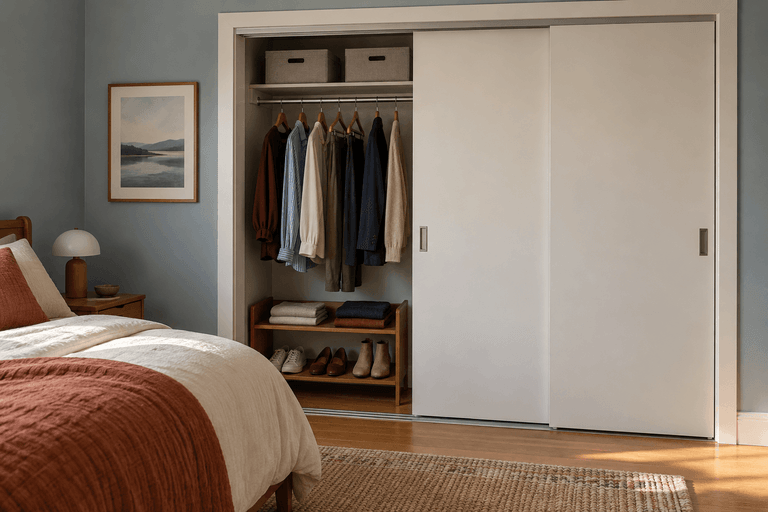
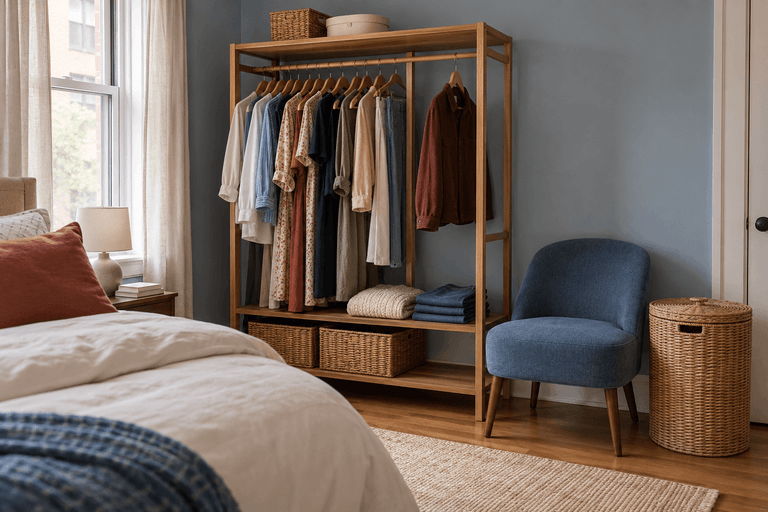
Open shelving and rails work well for items that are used daily and that can be kept tidy consistently.
Closed storage works better for things that are accessed occasionally, that don’t look good on show, or that would require constant tidying to keep a shelf or rail looking organized. In a small bedroom especially, concealed storage helps reduce visual noise and makes the space feel calm overall.
Use the Space You Already Have More Efficiently
Sometimes a bedroom feels overfilled not because there’s too much stuff, but because the room’s storage zones aren’t being fully used yet.
Before assuming the room has reached capacity, check for unused areas:
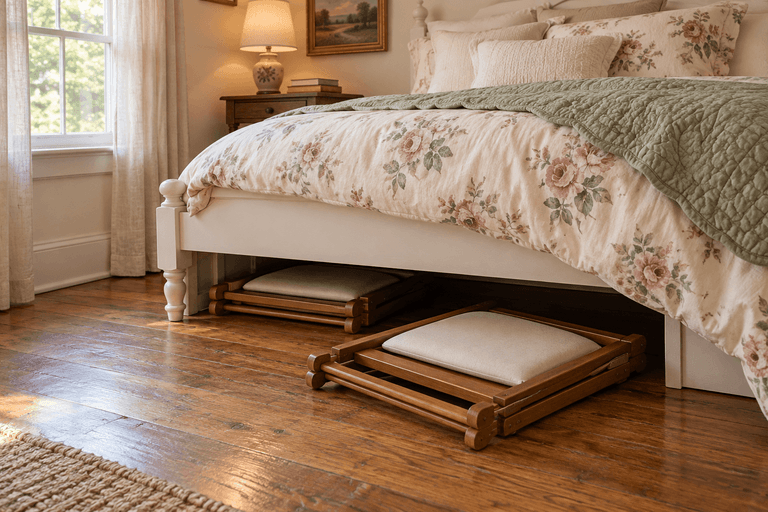
- Under the bed
- Above the wardrobe
- Behind the door
- Empty wall space
- Unused vertical height
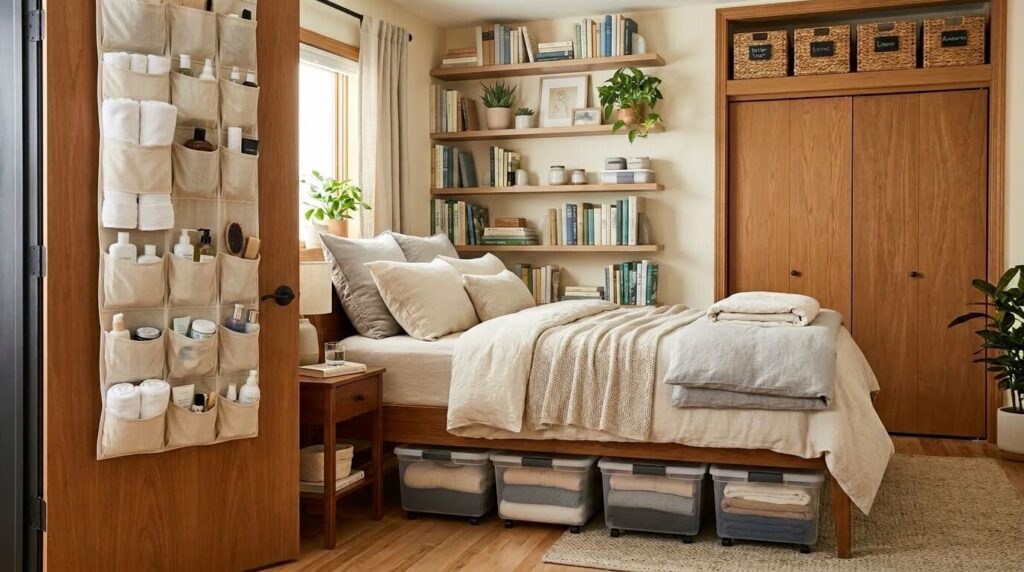
These zones often add more storage capacity than expected without increasing the room’s footprint.
The guide on small bedroom storage ideas for tight spaces covers these areas in more depth if the room still feels limited after decluttering.
The Habits That Stop Clutter from Returning in a Small Bedroom
A room that’s been properly edited and organized will fill back up without a few simple habits in place. None of them require much effort. They just need to be consistent.
The one-in, one-out rule
One of the easiest ways to prevent gradual build-up is attaching removal to acquisition. For every new item that comes into the bedroom, one leaves.
A new pair of shoes means an old pair goes. A new hoodie means an old one moves on. If a new storage basket enters the room, it only because it’s solving a genuine problem than adding more visual bulk.
Applied consistently, this keeps the volume stable without requiring periodic big clear-outs.
The daily reset
Five minutes at the end of the day, returning everything to its designated home keeps the gap between tidy and untidy small enough that catching up never becomes a project.
The reset works because it happens before the drift compounds. A single day of things left out of place is easy to correct. A week of drift is discouraging and takes real effort to undo.
For a full breakdown of the reset routine and how to build it into a daily habit, the post on how to hide clutter in a small bedroom covers both the quick fix and the longer-term maintenance habit.
Seasonal rotation
Moving out-of-season clothing, shoes and bedding into under-bed boxes, vacuum bags, or storage elsewhere in the home if viable twice a year keeps the active storage in the room sized for what’s actually being used rather than for the full years’ worth of belongings.
It’s the most effective habits for maintaining a small bedroom long term.
When the Real Problem Is the Layout, Not the Stuff
Occasionally, the room still feels cramped even after serious declutter. At this point, the issue may be the furniture arrangement rather than the amount of stuff.
Oversized furniture, blocked circulation paths, bulky storage placed on the wrong wall, or unused vertical space can all make a bedroom feel more crowded than it actually is.
If the storage setup still feels inefficient after editing down properly, reviewing the room layout itself is often the next step. The series on small bedroom layouts covers how furniture arrangement affects both storage capacity and how spacious a room feels.
Less First, Then Organize
The biggest breakthrough in a small bedroom with too much stuff happens when the room stops trying to hold more than it comfortably can.
Once the excess is out, organization becomes easier, storage works better, and maintaining the room takes far less effort. The systems finally hold because they’re no longer under constant pressure.
Start with the edit. Remove what doesn’t belong, then organize what’s left properly.
That is what turns a crowded bedroom back into a functional one.