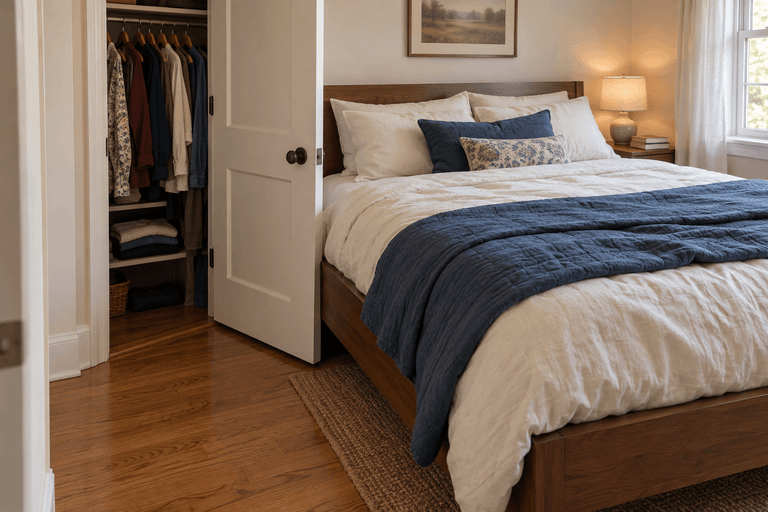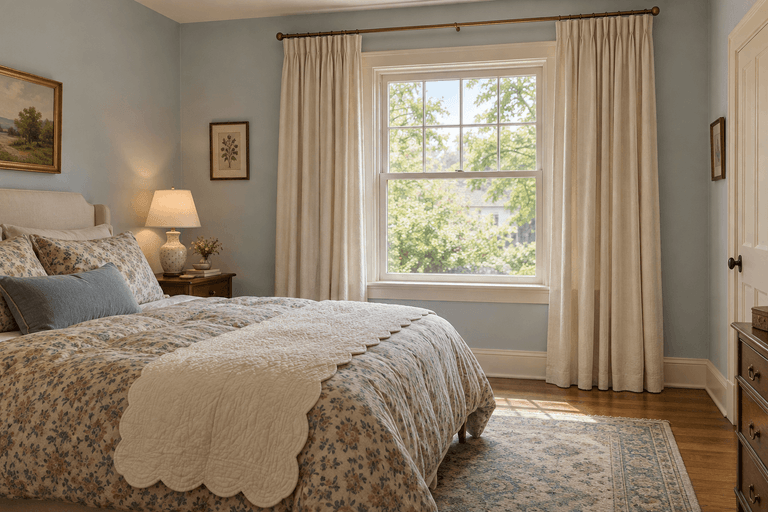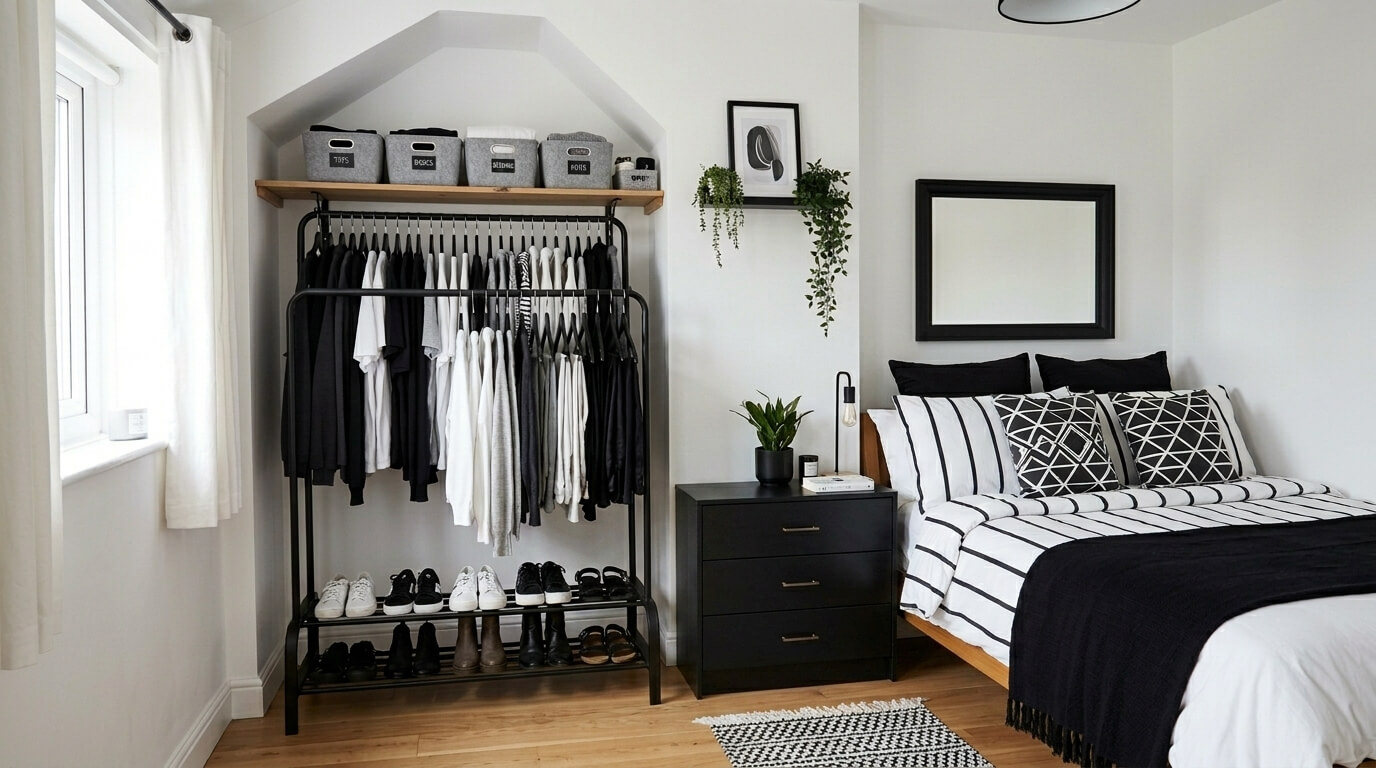
Best Layout for a Small Bedroom With No Closet
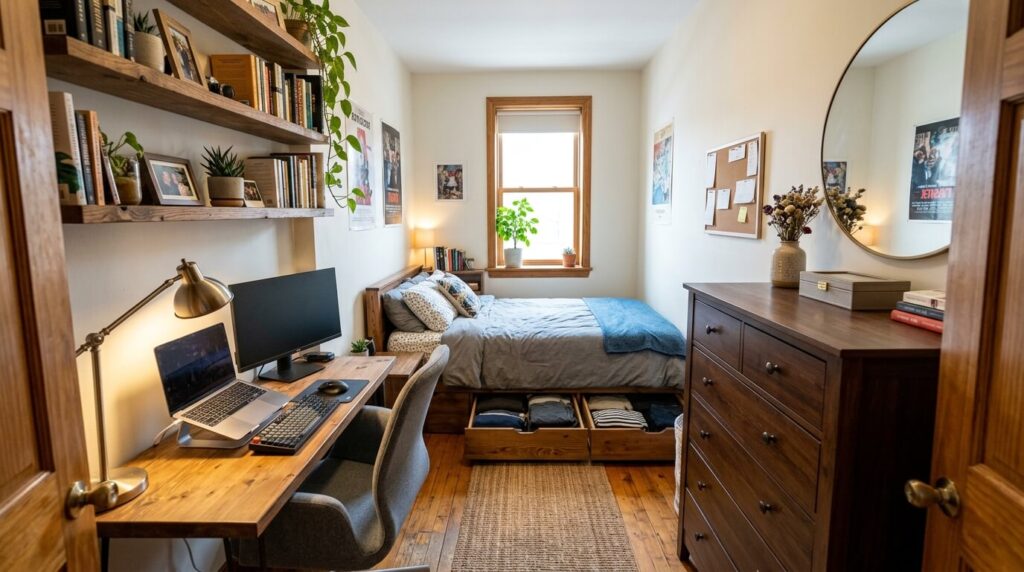
A small bedroom with no closet can feel harder to arrange than a room that simply short on space, because you are dealing with two problems at once: limited floor space and no built-in storage.
Clothes, shoes, bedding, and everyday essentials need a home, but every wardrobe, a clothing rail, or chest of drawers, takes up room that the bedroom itself needs to function.
The good news is that a bedroom with no closet can work just as well as one with built-in storage when the layout is planned properly. The mistake most people make is treating storage as an afterthought. In reality, storage should be one of the first decisions you make because it affects where the bed goes, how open the room feels, and how easy it is to move around.
This guide covers the best layout for a small bedroom without a closet, where to place a wardrobe or clothing rails, and the smartest ways to add storage without making the room feel cramped.
Start With Storage First, Not the Bed
In most bedrooms, the bed is placed first because it is the largest piece of furniture. In a small bedroom with no closet, that logic can backfire.
A wardrobe or a large clothing rail is a significant piece of furniture with specific placement requirements. It needs wall space, it needs clearance, and it needs to sit somewhere that doesn’t block the main circulation path through the room or compete with the bed for the same wall.
If the bed goes in first and those requirements haven’t been accounted for, the wardrobe ends up wherever it fits rather than where it works, blocking movement or dominating the room in the process.
Instead, decide on these first:
- Do you need hanging space, drawers, or both?
- Do you prefer open or closed storage?
- Which wall can handle the largest storage piece?
- How much floor space must stay clear?
Once storage is chosen, place the bed around it. That single shift usually creates a far better small bedroom layout with no closet.
The Best Wardrobe Positions in a Small Bedroom with No Closet
In a small bedroom, a wardrobe in the wrong position can make the room feel blocked and difficult to move through regardless of how well-chosen it is.
On the short wall facing the bed
This is usually the strongest wardrobe position.
The short wall at the foot of the bed sits in the natural sightline from the bed, which makes the wardrobe feel like a deliberate focal point rather than a large object that was slotted in wherever it would fit.
More practically, placing the wardrobe on the short wall at the foot of the bed keeps the long walls free, which helps the room feel wider and less crowded.
If possible, choose a wardrobe close to ceiling height to give the room a built-in quality and maximize storage.
Along the long wall beside the bed
When the short wall isn’t available, perhaps because of a door, a window, or limited width, the long wall beside the bed is the next best option.
A wardrobe on the long wall works best when it’s positioned at the far end of the wall from the door, so it doesn’t immediately dominate the view when you walk into the room.
Use a slimmer wardrobe here of around 18 to 20 inches deep. A standard wardrobe is around 24 inches deep, and that makes a narrow room feel tight.
Further, keep the bed and wardrobe grouped together and leave the remaining wall space open.
These approach prevents the room from feeling scattered.
In an alcove or recess
If the room has an alcove, a chimney recess, or any kind of architectural indent, use it. This is premium storage space that would otherwise contribute little to the room’s function.
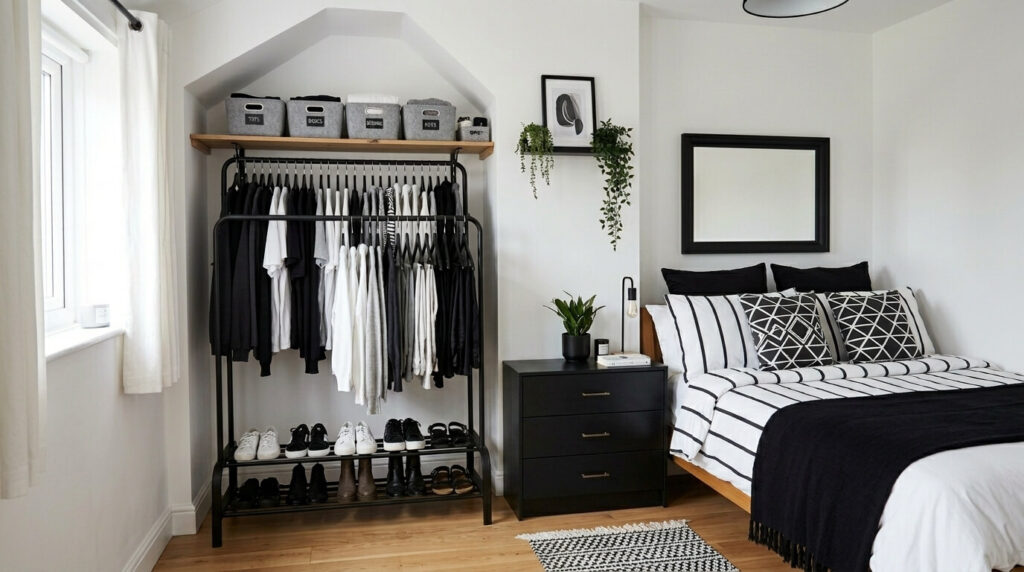
A wardrobe or shelving system fitted into a recess space, or if the recess is deep enough for hanging clothes, a fitted hanging rail with shelving above it can replace a freestanding wardrobe entirely, which frees up a wall for other uses.
Built-In vs Freestanding Wardrobes
Built-in wardrobes almost always serve a small bedroom better than freestanding ones, provided the budget allows for them. They use the full height of the room from floor to ceiling, they sit flush with the wall hence look cleaner and less bulky, and they can be configured precisely for the storage needs of the person using the room.
Freestanding wardrobes are more accessible financially and easier to take with you when you move, but they rarely use the full ceiling height, they project further into the room, and the gap between the top of the wardrobe and the ceiling is wasted space that also collects dust.
If built-in isn’t possible, choose a freestanding wardrobe that’s tall rather than wide, with plain doors rather than clutter, or one with sliding doors if the room is tight.
Best Open Storage Ideas for a Bedroom with No Closet
Open clothing storage, handled well, can take up less visual space than a solid wardrobe and give the room a lighter, more intentional feel.
Freestanding clothing rails
A clothing rail is the most flexible open storage option because it can be positioned almost anywhere in the room and moved if the layout needs to change.
A single rail with enough length can be used for current season clothing, favorite everyday pieces, and outfits worn often. Works well in a corner or against the short wall, provided the clothing on it is kept edited and organized.
Wall-mounted rails and hooks
These take the clothing storage off the floor entirely, which is a significant advantage in a small bedroom.
A wall-mounted rail fixed at the right height functions the same as the hanging section of a wardrobe but without the carcass, the doors, or the floor footprint.
In a room with high ceilings, a double rail system, one rail above the other for shorter items like jackets and folded trousers, uses the vertical space effectively without widening the footprint.
Wall-mounted hooks near the door handle daily-use items, coats, bags and frequently worn pieces, in a position that keeps them accessible.
Use a Smaller Wardrobe Overall
The truth is that many people do not need many clothes accessible in one room as they think.
A capsule wardrobe approach, keeping only the pieces that are worn consistently and storing seasonal items elsewhere in the home, means the storage solution in the bedroom can be smaller and lighter than it would need to be if the full wardrobe were kept in the room.
How to Make Open Clothing Storage Look Good
The difference between open clothing storage that looks like a deliberate design choice and open clothing storage that looks like a temporary measure comes down almost entirely to how it’s curated and presented.
Keep it sharp by using:
- Matching hangers reads as considered and intentional
- Organize the clothes by color on the rail makes the storage look purposeful
- Have enough spacing between clothes
- Have a basket for accessories
- Defining the clothing zone with a rug underneath it or a pendant light above it
Use the Bed as Storage
In a bedroom without a closet, under-bed storage becomes even more important than it is in a room with one.
The space under the bed is the best place for items that aren’t needed daily, including seasonal clothing, spare bedding, shoes that aren’t in regular rotation, and anything that would otherwise need its own storage piece somewhere in the room. A bed frame with built-in drawers or a lift-up ottoman bed handles this most cleanly.
Alternatively, for bed frames without storage, flat storage boxes on castors or vacuum compression bags for bulkier seasonal items make the under-bed space as functional as possible.
How to Arrange the Rest of the Room Around the Storage
Once a storage solution is chosen and positioned, the rest of the room layout follows from it. The bed, the dresser if one is still needed, and any additional furniture arrange themselves around the storage anchor point rather than competing with it for the same wall space.
If wardrobe is on the short wall
The bed goes on the long wall and the remaining section of that long wall is available for a desk, a dresser, or wall-mounted shelving. This is usually the most balanced arrangement in a small rectangular bedroom. This is because each major piece of furniture has its own wall and the floor space in the centre of the room stays relatively open.
If wardrobe on the long wall
The bed goes on the opposite wall or on the same long wall. The short walls on the other hand become available for smaller storage pieces such as a desk. Alternatively, it can be kept deliberately clear to give the room somewhere to breathe.
If using clothing rail
The clothing zone can sit in a corner or at one end of the room, bed on the main wall with drawers under the rail or under the bed.
Use Vertical Space Aggressively
The vertical space above head height is one of the most consistently underused resources in the room. Using that space strategically adds meaningful storage without touching the floor area at all.
Shelving above the wardrobe
A shelf or a series of baskets placed on top of the wardrobe, or a fixed shelf mounted to the wall above it at the same depth, handles bulky items that are accessed infrequently, spare duvets, luggage, seasonal items in labelled boxes. The items stored here are out of the main sightline and don’t add to the visual clutter of the room at eye level.
Over-door storage
The back of the bedroom door is another piece of vertical real estate that’s often ignored. An over-door organizer with pockets handles shoes, accessories, toiletries, or small folded items. A row of hooks on the back of the door handles bags, belts, and frequently worn outer layers
Hooks and wall-mounted organizers at height
A row of hooks mounted higher on the wall than the standard picture-rail height, at around six and a half to seven feet, handles items that can be hung without needing to be immediately accessible at arm’s reach.
Bags, hats, scarves and out-of-season jackets stored at this height are visible but not intrusive, and they free up lower hooks and hanging space for daily-use items.
A wall-mounted peg rail rather than individual hooks keeps this looking organized rather than cluttered, since the uniform spacing and consistent form of a rail gives the storage a visual coherence that a collection of mismatched hooks doesn’t.
Mistakes That Make a Bedrooms with No Closet Feel Worse
Too many small storage pieces
A small chest here, a rail there, a few baskets on a shelf, a stack of boxes in the corner may feel like a reasonable solution to a specific storage need, but together they fragment the room into a series of disconnected storage zones. Collectively, they use more floor space than a single well-chosen wardrobe would, and make the room feel cluttered and unresolved.
Consolidate storage whenever possible.
Choosing width over height
A wide wardrobe takes up wall space that could serve other purposes. A wardrobe that’s tall rather than wide, stores a comparable amount while using a lesser footprint.
Letting clothes spread across the whole room
When clothing storage starts to expand beyond its designated zone, with rails creeping along multiple walls, boxes accumulating on the floor, and additional storage pieces filling every available corner, and chairs, the room stops feeling like a bedroom and starts feeling like a storage unit with a bed in it.
Set a clear boundary for the clothing zone and keep it contained.
Ignoring visual calm
Open rails, shoes on the floor, overflowing tops of wardrobes, and random bins all make the room feel smaller.
Storage should hide chaos, not display it.
A Small Bedroom with No Closet Can Work Beautifully
The absence of a built-in closet is a genuine constraint, not a disaster.
Most rooms fail because storage is added randomly after the bed is placed. Once storage leads the layout, the room becomes easier to organize and easier to leave in.
Choose one strong storage solution. Use the vertical space. Keep the floor as clear as possible and make every item earn its footprint.
That is how a small bedroom with no closet stops feeling like a compromise and starts feeling intentional.