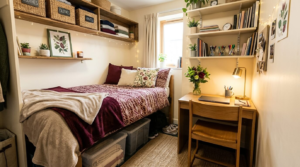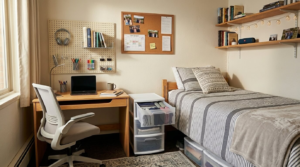
A small dorm room with a roommate rarely feels crowded because of square footage alone. Most dorm rooms are designed for two people. The problem is that two people arrive with two wardrobes, two study setups, two schedules and very different ideas about how the room should function.
The most successful shared dorm rooms are not necessarily the largest ones. They’re the ones where both roommates agree on a layout, establish clear storage zones, and give every item a designated home before clutter has a chance to take over.
If you’re trying to create a functional dorm room for two, the goal isn’t simply fitting everything inside the room. It’s making sure both people can live there comfortably without constantly getting in each other’s way.
Start with a Conversation Before Move-In Day
Most roommate problems in a shared dorm room begin long before the clutter appears. They start when two people arrive with different expectations about how the room should function.
One person assumes the closet will be shared equally. The other assumes whoever needs more space can use more space. One person plans to loft their bed. The other hates lofted beds. Neither conversation happens until move-in day, when one person is already unpacking.
A fifteen-minute conversation before the first bag is opened prevents most of the friction that develops later. Decide who takes which side of the room, whether the beds are being lofted or bunked, how the closet space will be divided, shared surfaces will be used.
Agreeing on the layout and storage framework in advance means move-in day produces a room that works for both people from the start rather than an arrangement one person tolerates and quietly resents.
Create Clear Personal Zones
The most functional shared dorm rooms have a clear answer to the question of whose space is whose. When belongings don’t have defined zones they naturally spread into shared areas. Clothing ends up on someone else’s chair, books migrate across desks, and bags start appearing wherever there’s empty floor space. A clear zone boundary prevents that.
Mirrored room layouts
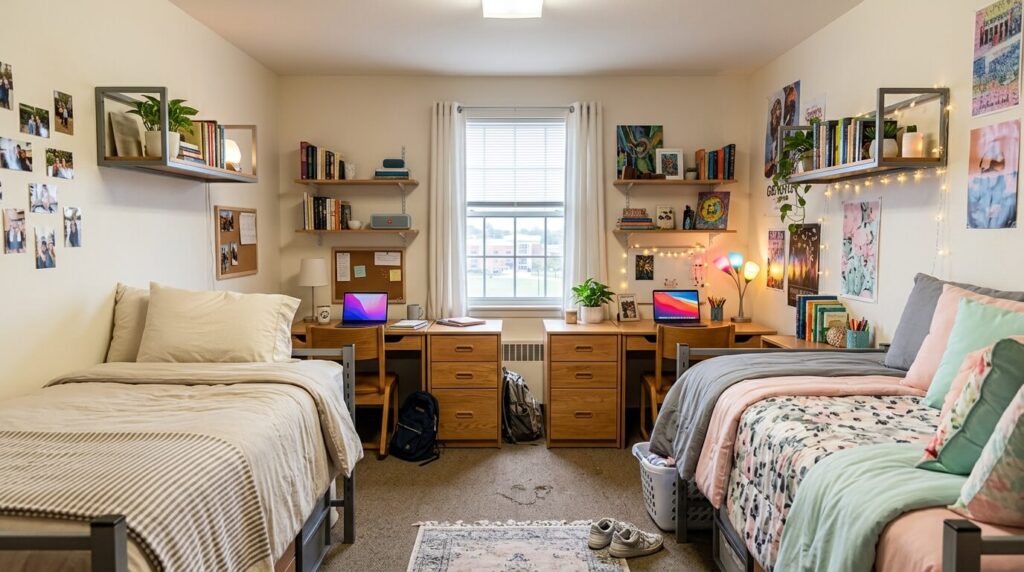
A mirrored layout gives each person the same configuration on opposite sides of the room. Each person has their own bed, desk, storage area, and wall space. Each side is a self-contained unit. The middle of the room is shared circulation space and stays clear.
This arrangement is easy to maintain because ownership is obvious. Everyone knows where their belongings belong, and there’s less opportunity for clutter to spill into someone else’s space.
Functional room layouts
Some dorm rooms work better when they’re divided rather than by person.
Both beds go on one wall, both desks on the opposite wall, storage concentrated at the ends. This creates a dedicated sleeping zone and a dedicated study zone, which makes the room feel more intentional and often more open than a mirrored split.
It however requires more cooperation between roommates because some areas are shared rather than individually owned.
Keep Shared Spaces as Clear as Possible
Personal zones are important, but the shared areas often determine whether a room feels organized or chaotic.
The floor, entryway, windowsills, mini-fridge top, and other communal surfaces should stay clear as possible. These areas affect both roommates, which means clutter here creates twice the frustration.
Establish floor rules
In most shared dorm rooms, the first sign the organization system is failing isn’t the closet or the desk, it’s the floor.
A backpack gets dropped beside the bed for a night. And a pair of shoes joins in. Then laundry basket gets left near the door. None of these things seem important individually, but in a room this small they compound quickly.
A clear floor is the shared resource that matters most in a small dorm room. When one person’s belongings start covering the floor in shared circulation space, the whole room becomes harder to live in for both people.
The simplest rule is that nothing lives on the shared floor permanently. Bags go under beds. Shoes go on racks or door organizers. Anything left on the floor is either put away or dealt with the same day.
Divide Shared surfaces
Shared surfaces work best when they’re divided intentionally. The windowsill, the top of the shared dresser if there is one, the space on top of the mini fridge: these surfaces become contested quickly if there’s no agreement about how they’re used.
Dividing them physically, is simpler than trying to manage them collectively. Equal division is easier to maintain than a vague shared arrangement where neither person feels responsible for keeping it tidy.
The door and entryway
The area immediately inside the door sets the tone for the whole room. Shoes piled near the entrance, bags dropped in the doorway, coats on the floor: this small area has an outsized effect on how the room feels.
An over-door organizer on the back of the door, a hook for each person beside the door, and a shoe rack or wall-mounted shoe shelf near the entrance gives everything that arrives with a person a home that keeps the entryway clear.
Make Storage Self-Contained
The most consistent source of friction in a dorm room with a roommate is storage that spills into the other person’s space.
Every item should have a home within the owner’s zone whenever possible. When clothing, books, or supplies begin overflowing into common areas, clutter multiplies quickly.
Use your wall space
Vertical storage is especially valuable in a room shared by two people. Each person can use the wall space above the bed, beside the desk, above the dresser for floating shelves, adhesive hooks and wall-mounted organizers. All of these add storage capacity without taking away precious floor space.
For more ideas, see how to maximize vertical space in a dorm room.
Maximize under-bed storage
Under-bed storage belongs to the person whose bed it is. Vacuum bags for spare bedding, flat boxes for shoes, rolling drawers for folded clothing allow each roommate to expand storage capacity without affecting the other person’s area. If one person lofts and the other doesn’t, the person at floor level needs to be particularly deliberate about using the under-bed zone well since they have less vertical wall space underneath a lofted bed to compensate.
Use door storage
The back of the door can hold far more than most students realize. Over-door organizers work well for toiletries, accessories, shoes, daily-use items. They add storage without requiring additional furniture.
For more ideas, see best over-the-door storage ideas for small dorm rooms.
Organize the Desk Area Carefully
The desk is where most students spend their productive hours, so keeping it organized has an outsized impact on the entire room.
Side by side desks
Desks placed side by side on the same wall create a shared study zone that uses the wall space efficiently and keeps the rest of the room open.
The drawback is that studying at the same time can be distracting. A low divider between the desks, a small bookcase or a pegboard panel, creates a visual separation that reduces distraction without splitting the zone into two separate spaces.
Desks on opposite walls
Desks on opposite walls of the room create maximum physical separation and privacy between the two study zones, which suits people with genuinely incompatible study habits.
It also distributes the visual weight of the room more evenly than putting both desks together, which can make the room feel more balanced.
For specific desk setups that work in shared dorm room spaces, the post on how to set up a productive dorm room desk in a small space covers the options for the ultimate productivity including roommate configurations.
Divide the Closet Space Fairly
Very few roommate disagreements begin with a major argument about storage. Most begin with small expansions that go unaddressed.
A jacket gets hung slightly beyond one person’s section of the rail. A pair of shoes appears on the wrong side of the closer floor. A bag ends up on a shelf that wasn’t originally assigned to anyone.
None of these things matter in their own. The issue is that the original boundary gradually disappears. Defining closet zones clearly from he beginning is less about fairness and more about preventing confusion later.
When the closet half is too small for both wardrobes, supplement it with compact drawer units or a freestanding clothing rail.
For a full range of no-closet clothing storage solutions that work in a dorm room, the post on how to organize a dorm room with no closet space covers every option in detail.
The biggest shared dorm room storage mistakes
The biggest mistake isn’t owning too much. It’s allowing personal belongings to migrate into shared spaces because individual storage systems aren’t working.
Once bags live by the door, shoes collect in walkways, and items spread across communal surfaces, the room starts feeling cluttered regardless of its size.
Whenever possible, keep personal belongings inside personal storage zones and keep shared areas open.
The Habits That Keep a Shared Room Livable
Storage systems in a shared dorm room need maintenance from both people to keep working. One person maintaining their side while the other lets theirs drift creates an imbalance that generates resentment fast.
The habit that works is simple: each person is responsible for their own zone. Put your own things away at the end of the day. Keep your belongings within your own space. Don’t let your storage expand into shared areas without a conversation. These aren’t rigid rules. They’re the baseline that makes two people sharing 150 square feet tolerable rather than stressful.
The shared spaces, the floor, the entryway, the surfaces neither person owns, need a joint reset at least once a week. That’s all. A few minutes each to put shared items back where they belong and clear the circulation space. It’s a small investment that prevents the slow drift that turns a manageable shared room into one that both people feel like they’re living around rather than in.
For the full approach to getting a shared dorm room organized from the start, how to organize a small dorm room when space is limited covers every zone of the room with the same practical approach.
Organize together Before You Unpack
The best shared dorm rooms aren’t usually the most expensive ones. They’re the systems that prevent small problems from becoming permanent frustrations.
Clear storage boundaries, agreed layouts, and designated homes for everyday items matter far more than matching organizers or extra furniture.
Most roommate conflicts around clutter aren’t really about clutter at all. They’re about unclear expectations. Establish those expectations before move-in, and the room becomes significantly easier to share for the rest of the semester.