Most small bedrooms that feel cramped and uncomfortable are not actually as small as they seem. In many cases, the square footage isn’t the real problem. The problem is a set of layout decisions, that work quietly against the space and make it feel tighter, darker, and more crowded than it needs to be.
That is why some bedrooms feel uncomfortable even when they are tidy, and heavy, or awkward without any obvious reason. Usually, that comes down to layout rather than size.
The good thing is that layout mistakes can be fixed without renovating, spending heavily, or replacing every piece of furniture.
This guide goes through the most common small bedroom layout mistakes that make a room feel smaller, why they happen, and how to fix them.
The Bed Is on the Wrong Wall
This is one of the biggest reasons a bedroom feels awkward.
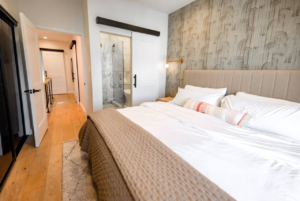
In many rectangular rooms, the bed works best on the longest wall. When it’s on the short wall instead, the leftover floor space often forms a long narrow strip in front of it. That makes the room feel like a corridor instead of a bedroom.
Sometimes the short wall seems like the easiest option because of windows and doors. If you’ve tried every arrangement you can think of and the room still feels wrong, check the bed wall first.
Fix:
- Test the bed on the longest uninterrupted wall
- Keep walking space on the side you use most
- Rearrange smaller furniture after moving the bed
The Furniture Is Too Big for the Room
Scale is one of the most common sources of trouble in a small bedroom, and it’s one of the hardest to recognize from inside the room. This is because each piece of furniture tends to be evaluated on its own rather than in relation to the space around it.
Oversized beds in undersized rooms
A bigger bed in a room that’s genuinely eats up floor space and clearance that the room can’t recover from.
The bed ends up with furniture jammed in around it, the walking space in the room shrinks, and the whole arrangement feels forced.
Wide low dressers on long walls
A wide, low dresser placed along the long wall of a small bedroom spreads across the wall at eye level, competes visually with the bed on the opposite side, and narrows the sightline through the room.
Deep sofas and chairs that block circulation
A small armchair or a bench at the foot of the bed sounds appealing but in a room where the clearance between the foot of the bed and the facing wall is already tight, adding a chair reduces the main walkway.
Fix
- Choose slimmer pieces scaled down to room.
3. Everything Is Pushed Against the Walls
This feels like the right thing to do but often backfires.
Many people place furniture on every wall hoping to free the middle of the room. Instead, the room feels boxed in and the center becomes leftover space rather than open space.
Rooms feel larger when at least one wall, or part of one wall, has breathing room.
Fix
- Leave one wall visually lighter
- Use fewer furniture pieces overall
- Avoid filling every corner just because it is empty.
4. The Room Has No Defined Zones
If your bedroom is also an office, dressing room, or study area, it needs clear zones. When everything is everywhere and no part of the room has a clear role, the room feels chaotic in a way that reads as clutter even when the surfaces are relatively tidy.
Zoning doesn’t require physical dividers or a lot of space.
Fix
- A rug under the desk area defines the work zone
- Task lighting at the desk
- A bookcase placed at the side of the desk
- Different lighting for sleep vs work areas
Our post on Small Bedroom Layout with Desk and Storage Ideas looks in details on how define the room optimally.
5. The Storage Is in the Wrong Places
Storage problems in a small bedroom are rarely about having too little storage. They’re almost always about having storage in the wrong form or the wrong place, which means the room ends up feeling cluttered even when everything technically has a home.
These include:
Tall wardrobes on the long walls
A tall wardrobe on the long wall of a small bedroom projects into the room, narrows the visual width of the space, and makes the ceiling feel lower.
Freestanding storage that could be wall-mounted
Every freestanding storage piece in a small bedroom uses floor space that the room needs for walking and breathing room.
Ignoring under-bed storage
The space under the bed is the most underused storage area in most small bedrooms, and using it well can remove the need for an additional storage piece elsewhere in the room entirely.
Fix
Use storage where is wastes the least space
- Put tall storage on short walls
- Use wall shelves instead of floor units
- Use a bed frame with built-in drawers
- Use low-profile rolling bins or vacuum storage bags for seasonal items
- Replace open clutter with closed storage
6. The Lighting Is Working Against the Room
The way a room is lit affects how large and open it feels just as directly as the furniture arrangement does.
One overhead light doing all the work
A single overhead light in a small bedroom casts an even, flat illumination that flattens the room visually and makes it feel smaller than it is.
Layered lighting on the other hand makes the room look bigger because the light creates areas of warmth and shadow rather than illuminating everything at the same level.
No dedicated light at the desk or beside the bed
Task lighting serves a functional purpose, but in a small bedroom it also does spatial work. A lamp beside the bed defines the sleeping zone. A lamp or a wall-mounted light above the desk defines the work zone.
Window light being blocked by furniture or heavy curtains
Natural light makes a room feel open and airy, and blocking it with furniture placed in front of windows or with heavy curtains that hang closed during the day works against the room.
Fix
- Keep the area directly around windows clear, and use curtains or blinds that can be fully opened during daylight hours
- Use multiple light sources at different heights like a bedside lamp, a desk lamp, and wall-mounted light
- Use a dedicated lights to create distinct differentiated zones
7. The Floor Is Too Cluttered
The amount of visible floor space in a room has a direct effect on how large the room feels, and in a small bedroom where the floor space is already limited, anything that reduces the visible floor makes the room feel tighter.
Fix
- Choose furniture with legs
- Use wall-mounted nightstands
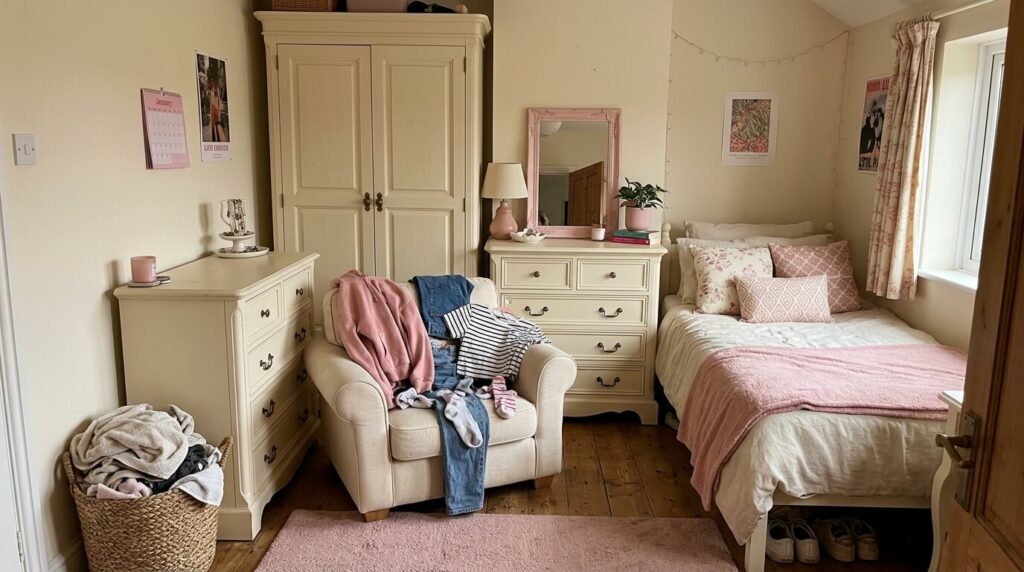
- Keep items such as bags, shoes, laundry and boxes off the floor.
- Use closed storage instead of open piles
8. Ignoring the Door Swing
A door that swings open into a bedroom and comes close to hitting the bed, a dresser, or a desk creates a pinched entry that sets a cramped tone for the whole room. Even if the door technically clears the furniture, the near-miss is felt every time someone walks in. This makes the room feel tight from the first step through the door.
Fix
- Map the full arc of the door swing and make sure the furniture arrangement gives it clear space
- Move nearby furniture
- Consider whether the door can be rehung to swing the other way. This small adjustment can improve the whole layout
9. The Room is Too Visually Busy
A cluttered visual style shrinks a room fast.
Too many colors and patterns
Too many colors, patterns, mismatched décor pieces, or random accessories create noise. In a small space where the eye doesn’t have far to travel in any direction, visual noise feels heavier than a large room
Decor that competes rather than connects
Decor items that have no visual relationship to each other, different styles, different scales, different finishes spread across the room, create a sense of visual fragmentation that reads as clutter even when the surfaces aren’t actually cluttered
Fix
- Limit the room to two or three main colors
- Use texture instead of too many patterns for visual interest
- Use lighter colors on the long walls in a narrow room to push the walls back and create a sense of openness
- Use a few strong pieces of decor that share a common quality, like material, color or style.
10. Mirrors Are Reflecting the Wrong Thing
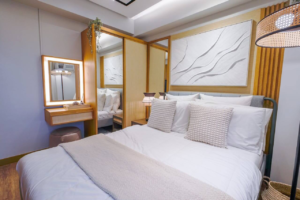
A mirror in a small bedroom is a genuine spatial tool because it reflects light and creates the impression of depth. But a mirror that faces a cluttered corner, a pile of clothing on the floor, or a wall covered in mismatched furniture doubles the visual chaos rather than the space.
A mirror works best when it reflects something worth reflecting: a window, a well-styled section of the room, or a clear wall.
Fix
- Position it to reflect something useful rather than simply placing it where it fits
Most of These Fixes Cost Nothing
That is the best part
Many small bedroom layout mistakes are solved by moving things rather than buying things.
The bed goes on a different wall. The dresser moves from the long wall to the short wall. The floor gets cleared. The curtains get opened. The under-bed space gets used. None of those changes require a single purchase, and any one of them can shift how the room feels more noticeably than a new set of cushions or a coat of paint.
Start with the bed placement because that one decision shapes everything else. Then work outward through the furniture sizing, the storage arrangement, and the visual layer. Small bedrooms usually feel smaller because of arrangement rather, not because of size. The room you have is more workable than it looks.